
Ad Disclosure
The Union are Back to Doing What They Do Best, Which is Bludgeoning the Other Team to Death with Wide Service

Published:
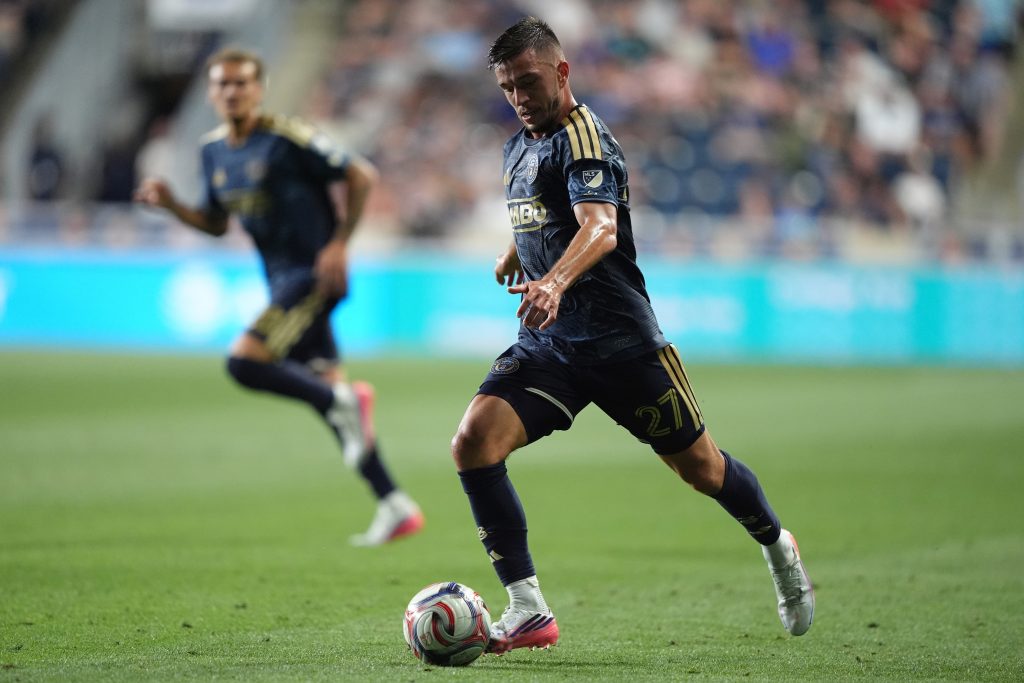
The Union won again on Saturday night, this time turning a 2-0 deficit into a 3-2 win with a pair of stoppage-time goals.
They were playing 11 vs. 10 for the better part of 70 minutes after Enea Mihaj’s first-half red card. It looked like it was going to be one of “those nights” at the Soob before the Union nicked one back in the 73rd minute before scoring in the 96th and 97th minutes to take all three points.
Look at the goals and tell me what you see:
All three goals coming down Kai Wagner’s left side.
He was credited with assists on the 2nd and 3rd goals, but not the first goal since it came off a defender before Milan Iloski was able to get behind and flick it home. But Wagner should get a half-assist in our hearts and minds because he took a touch and played an early ball with runners attacking the box. It wasn’t dissimilar to the goal they beat Seattle with, which came down Frankie Westfield’s right side but had the same early and direct quality. In the case of Saturday night, there aren’t a lot of transitional moments when you’re playing up a man, but the Union manufactured a pseudo-counter there with more urgent play.
Funny enough, the 2nd and 3rd goals, which were assists, looked a lot different. At that point you’re chasing the game and need an equalizer so you start just lumping balls into the box from wherever. One found the head of a 6’7″ center back and the other was caught flush for a worldie.
Interim head coach Ryan Richter said this afterward about attacking from the flanks:
“It was clear that this was how we were going to have to break teams town, is going through the wide areas, (but) hoping to get into more dangerous crossing positions, crossing from inside the box, getting to the endline, these cutbacks and chipped balls, which we had a couple of opportunities. Quinn (Sullivan) played one for Milan and Danley (Jean-Jacques) had the chipped ball for Neil. A couple of really good opportunities when we got into those positions, or the one where we drive to the endline, cut back, chipped ball to the back post, we talked about that at halftime, how we can break them down in the second half. It would have been tough to combine through (Atlanta), just the way they’re set up, so playing crosses, not just kicking the ball into the box and getting impatient, but trying to find good positions and higher-percentage positions we can cross from.”
There’s a bit to unpack there.
Lumping crosses into the box is generally seen as a lazy and ineffective against a bunkering team, which may or may not be playing down a man after a red card. If you watched Mexico vs. England in the World Cup, El Tri decide to keep hoofing it into the box for Raul Jimenez, who by that point was up against 6’7″ Dan Burn and two other center halves in a defensive shell. They didn’t come close to finding a third goal with that approach.
What Richter is saying is that he knows crossing the ball is a Union strength. It’s actually the main box-entry method, with the Union for example leading MLS in 2025 with 743 crosses en route to the Supporters’ Shield. They’re second with 429 crosses this season. But it doesn’t mean you necessarily settle for static outswingers from the deep flanks. If you watched the game from 60 minutes on, you saw a lot of interchange and overload on both sides, Quinn and Cavan Sullivan, for instance, working combinations on the right and getting into better positions for these cutbacks and chipped balls that Richter is talking about.
If you’re a defender and you’re standing back to goal, attacking an outswinger from a fullback is relatively easy. It’s a floated ball that’s moving away from you with side spin. But when you’re turned towards the endline or the corner flag, and the distances are shorter and the flight of the ball is less lofty, that’s where you get into trouble. You have less time to react and it’s harder to feel out attackers running in behind. Offside doesn’t come into play and there’s no bailout from holding the line.
To that point, the goals the Union scored came with an xG of 0.16, 0.08, and 0.05, in that order. They had 16 shots that didn’t even hit the target, 8 that were blocked, and 3 that were saved. So it’s funny to think that when they worked to create better chances, those didn’t pan out, but when they got desperate and had to start launching it into the box, that ended up working.
But however it looks, it’s typically effective for this team.
“When you see how it goes, 90% (of the chances) come from wide balls,” Wagner said on Saturday night. “I know what I’m capable of with the ball. Frankie (Westfield) is the same player like me as well. We just need the runs. Today we had a lot of chances to even score more goals. Milan had a big off his head at the end (a free header around the six-yard mark). We could have maybe scored the goal a little earlier, but we know what we’re capable of, the outside backs. We just have to find the better runs and that’s where we need to train a little bit more and look at the film.”
The Union are a completely different team with Wagner back in the fold. He already has three assists in three games since rejoining the Union from Birmingham. And his return allows Westfield to return to right fullback, where he can continue to build on the team-leading five assists he’s logged so far. The U have scored seven goals under Ryan Richter and all seven of them involved a fullback in a wide area. By the end of the season, expect Westfield and Wagner to be #1 and #2 in Union assists.
Looking at the table, this team is 13th in the East with four wins, 10 losses, and four draws. But they’re 3-0-0 since the World Cup break and seven points off the playoff line. If they continue to play like this, they’ll make the postseason. There’s another pause here for the Leagues Cup, then a huge test in mid-August with NYC FC and Miami in consecutive games. We’ll learn a lot more about this team in a few weeks, and whether or not they can pull a Philadelphia Flyers and go on a 3.8%-type of run.
Kevin has been writing about Philadelphia sports since 2009. He spent seven years in the CBS 3 sports department and started with the Union during the team's 2010 inaugural season. He went to the academic powerhouses of Boyertown High School and West Virginia University. email - k.kinkead@sportradar.com