
Ad Disclosure
Q/A: A Few Good Minutes with La Salle’s Darris Nichols, Who Thinks the Explorers Have More Skill to Pair With a “Non-Negotiable” Toughness

Published:
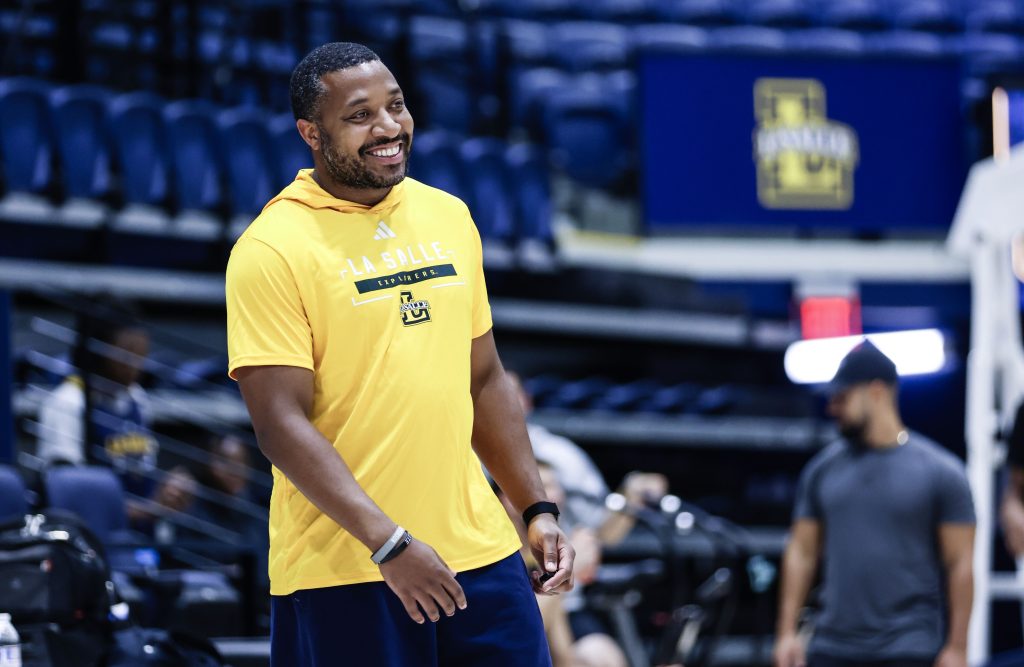
In a tiring world of coach speak, canned quotes, and useless platitudes, Darris Nichols is a noticeable outlier.
La Salle’s head basketball coach will tell you how it is, good or bad, and whether you need to hear it or not. That much was refreshingly evident in a recent visit to Glaser Arena, where Nichols ran a high-tempo summer session best described as demanding, but fair.
Maybe it’s an innate trait, this inability to bullshit. Or maybe it’s learned behavior from a half-decade in West Virginia, where he played under both John Beilein and Bob Huggins, going to the Elite 8 and Sweet 16 on teams that included college basketball studs like Kevin Pittsnogle and current Sixers President of Basketball Operations, Mike Gansey.
Nichols and I shared a sociology class in Morgantown, and connected when he took the La Salle job last season. It was a tough year for the Explorers, who won nine games and exited the Atlantic 10 tournament with an 18-point, first round loss to St. Bonaventure. Nichols inherited a team that returned a grand total of one player from Fran Dunphy’s final season, and essentially had to start from scratch, though such is the nature of NIL and the transfer portal in a transactional college basketball landscape.
But Nichols likes his current team, which he says has a mixture of the toughness and shot making ability that defined the crossover period between Beilein and Huggins almost 20 years ago.
We sat down recently to talk about it.
Crossing Broad: Tell us about this group. What’s the outlook for the Explorers in 2026 and 2027?
Darris Nichols: I think the biggest thing is last year we couldn’t shoot. Three point shooting was our biggest issue. But this year we’ve addressed that. We’ve got some guys who can really make shots. I think we’re more skilled than we were a year ago and I just like our versatility, offensively and defensively. I think we’ve got size and length. We’ve got speed. Our biggest thing this year, we’re going to try and play faster than we have in the past and when you’ve got guys that can make shots, you can do that. I know everybody is excited about their team at this time of the year, but just who these guys are, coming in every day and working, I think we have the right type of guys.
CB: How do you improve shot making outside of going out and getting shot makers? Can you shoot a million shots in practice?
Nichols: You can get a lot of reps in. We (started) official practice Sunday (September 20th), so we’ll have more hours to do shooting groups, get them more reps throughout the day. But the biggest thing is recruiting it. Recruiting guys who can make shots, because it’s hard to turn guys into shooters now. You have them for six months and then they transfer. A lot of times, if you get guys who can’t already do something, it’s harder to develop it.
CB: I guess that paves the way for going deep, expanding the rotation, and finding tough, two-way guys who can rebound and grind. Does that lend itself to the way you play, the types of guys you’re able to recruit and bring to La Salle?
Nichols: Yeah. I think that in the transfer portal you’re paying for skill. If you have a lot of money, you can pay for skill and toughness. When you’re limited on resources, like we are, your first thing is that they had better be tough. And then whatever they can do after that is an add-on.
I was talking to Billy Donovan a few years ago and I asked him, “If you were a college coach, if you went back right now, what would be the #1 thing you value?” And he said toughness. He said that back in the day you had guys for 3 or 4 years, and you can make them tougher over the years, but now you can’t do that anymore. So the first thing we value is toughness. That’s non-negotiable.
CB: I was happy to see Rob Dockery come back. What actually happened there? There was chatter that he was entering the portal. Did that even happen?
Nichols: We lost so early in the conference tournament that the portal didn’t open up for another two weeks. People were saying he’s “expected” to go into the portal but it hadn’t even actually opened. I don’t know where that information came from because he never entered the portal. We had conversations with him and shared a vision with him. He’s comfortable around us. I don’t think he was ready to go back to that high-major thing, where guys… I don’t think he was ready to be a “piece.” A guy that came from Texas A&M, where, when things weren’t working out, they kind of kicked him off to the side. I think he wanted at least another year where he could develop in-game. That was a big thing for him, having a bigger role than he did last year. And getting his shooting percentages up before whatever jump he wants to make next.
CB: Was that something you had to pitch specifically to him? How receptive was he?
Nichols: I took him upstairs (to the gym). It was me and the assistants and we kind of simulated a game. We were running through some plays and Rob made a mistake and we subbed him out of the game. Then we put him back in the game and we were kind of showing him what it would be like, that if he wanted to go and get paid that money, and move to a higher level, that his leash was also going to be shorter. We told him that and he knows how it would go. I think he trusts us and is comfortable here.
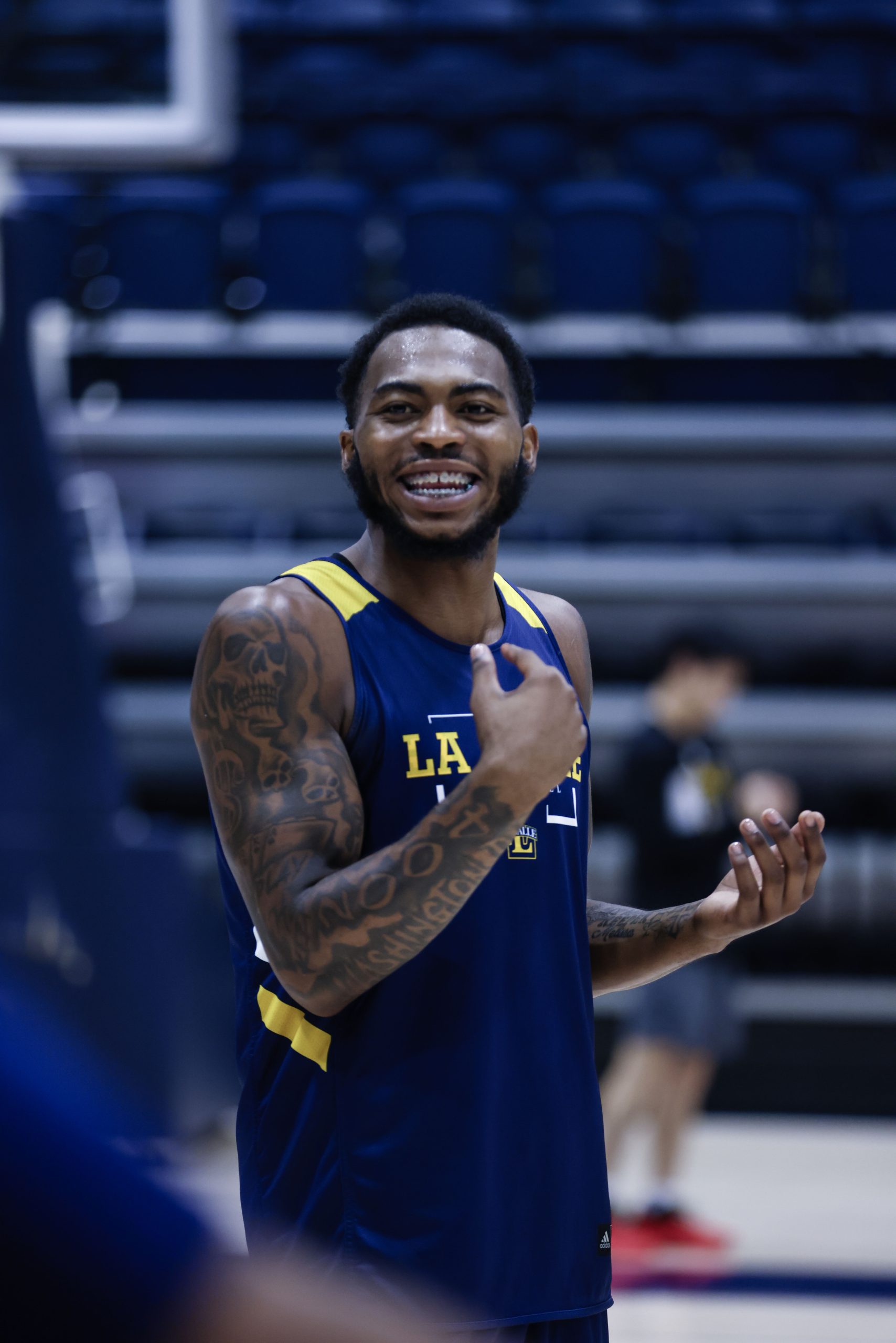
CB: Last year you had a brand new team. It was your first year here, but still, the roster was pretty much all new guys. Now Rob is back, Anthony Finkley came over from St. Joe’s. You’ve got transfers in from GW, George Mason, Stephen F. Austin and then some key pieces sticking around. How much more comfortable do you feel with at least some continuity going into this season?
Nichols: I think the years where we’ve had 3-5 returners we’ve been better. I think in this climate that retention is everything. You have Jaden Johnson returning, who is our starting point guard. You have Rob Dockery. Noah Collier, who, when healthy, is probably one of the better bigs in the league. Bowyn Beatty. Those (returning) guys, and now you know what pieces to put around them. Now you can be strategic in who you evaluate. Last year, when I got the job, I was like, “Shit, there’s only one guy on the roster.” We had to go get a whole bunch of guys. You can piece it together better this year than last year.
CB: Can I be honest with you? I think the worst thing about college basketball right now is that the students and the fans don’t hate the opposing team enough. Because they don’t know who these guys are. When I watched you play at WVU, whether it was against Pitt, or UConn, whomever, we saw those matchups against those same players year over year over year. And so there was a familiarity that contributed to the rivalry. We couldn’t stand guys like Carl Krauser and DeJuan Blair and Ronald Ramon. Now you have to bring a roster sheet to study ahead of time just to learn who’s on the opposing squad.
Nichols: Yeah, I think back then, when we were in school, you all grew with each other. You know what I’m saying? We came in as freshman, we were all eating Bosco Sticks together in Lyon Tower (editor’s note: Bosco Sticks are an unfried version of a mozzarella stick, not a single ingredient of nutritional value)… But then it was like, “Shoot, he’s a junior,” and we’re off campus. You may not know each other but there’s definitely familiarity with each other. So then it’s like, “Do we really hate that team, or do we like our own team that much?” Now we’re really pushing for our team because we know those guys.
I tell my guys this all the time, and I use you as an example, I say, “Listen, you guys that walk around campus, and you don’t speak to anybody, you don’t interact with anybody, you’ve got it all fucking wrong.” Because, think about this – I get this job and one of the best-known writers in the city was in class with me and I didn’t know that at the time. Now imagine I was an asshole! (laughing) Seriously. You never know where people are going to end up. You never know what’s going to happen. But we weren’t thinking that at the time, like “Oh I gotta do right because (of what might happen in the future),” that’s just who we were. So that’s who y’all need to be.
CB: It’s hard being 19 and thinking about what’s going to happen when you’re 40. But you’re right. You never know who you’re going to run into. You’re here. Mike Gansey is with the Sixers. Zach Spiker is from Morgantown and coaching at Drexel now. Joe Mazzulla is coaching the Celtics. It’s probably hard to instill that thinking in college kid, but it’s something you realize later and it makes a lot of sense.
You mentioned earlier that you only have these guys for 6-7 months while your coaches had you guys for 3-4 years. Does it put a ceiling on the product? How far can you really take these guys in a short amount of time? Or – does it frustrate you as a coach to make progress and think you’re going to lose a bunch of these guys?
Darris Nichols: No. (pauses)… The (coaches) that it frustrates are either retiring or about to get out of the business. They’re sick of it. It hasn’t frustrated me to that point because I look at it differently. I say to myself, “I got into this to make a positive impact on young people.” That’s why I got into it. I used to think that when I had guys for 3-4 for years, I’d make a 3-4 year impact on them. Now I only have them for maybe two years. I’m just impacting more people than I used to. I’ve thought about it differently. Maybe I’m not with them for as long a period of time, but if I can’t make a positive impact on a kid in a year, then I don’t need to be doing this.
CB: Did you have any preconceived notions about the Big 5, and if so, what’s your current perspective having been here for a year?
Nichols: I love the history of it. I think we can do a better job of bringing more excitement to it. In the past, a lot of local guys stayed in the area. They played for local teams. It’s like what you were talking about earlier. They (fans and media) grew with those players from high school to college. They knew those guys in high school. That brings more excitement. I don’t think you have that as much because local guys don’t stay as much as they used to. But I feel like there’s a way to create more excitement, and that’s with Big 5 Saturdays. I think if we were to set aside Big 5 games the second Saturday in November, and the third Saturday, so there’s a game at 2 p.m., 5, 8, and you can bounce around the city, two Saturdays in a row before we go down to Xfinity…
CB: Just having more days the Big 5 can own.
Nichols: Yeah, like Temple is at La Salle at noon, then I’m gonna catch Villanova and Penn. I think it could build excitement if you did that on certain days.
CB: It’s tough with media coverage. You’ve been here long enough to know that it’s the Eagles, then the Phillies. The Sixers got LeBron. The Flyers are turning a corner. After that, there isn’t much bandwidth for anything else in a pro sports town. Maybe this is a question I should ask myself instead of you. But to the point, if there’s only so much attention to go around, you may as well try to maximize it.
Nichols: Let’s make it the same thing, yeah.
CB: I get the sense the students don’t care as much as they used to. But I like the way we do it on this website. We have a St. Joe’s guy. He doesn’t like Nova. And the Nova guys don’t like Temple and the Temple guys don’t like St. Joe’s. It’s tribalism, but I think tribalism can be healthy if it adds juice to rivalry.
Nichols: The only thing I can say is that if you bring in more local kids, it adds more excitement. (note: La Salle now has three Philly guys, including two from Roman Catholic, and two from South Jersey). Not a lot of people recruit high school anymore. A lot of people are focusing on the portal. But I don’t know how to recreate that.
CB: Winning games helps. People can’t ignore you if you win.
Nichols: Yeah, but you have to do stuff before you win, too. There’s a lot that goes into winning. And not every Big 5 team is going to be a winning team every year. I just think creating consistent atmospheres helps. Games used to be at the Palestra, now (the Big 5 Classic) at Xfinity. I just think that if you keep it consistent that people can prepare for it better.
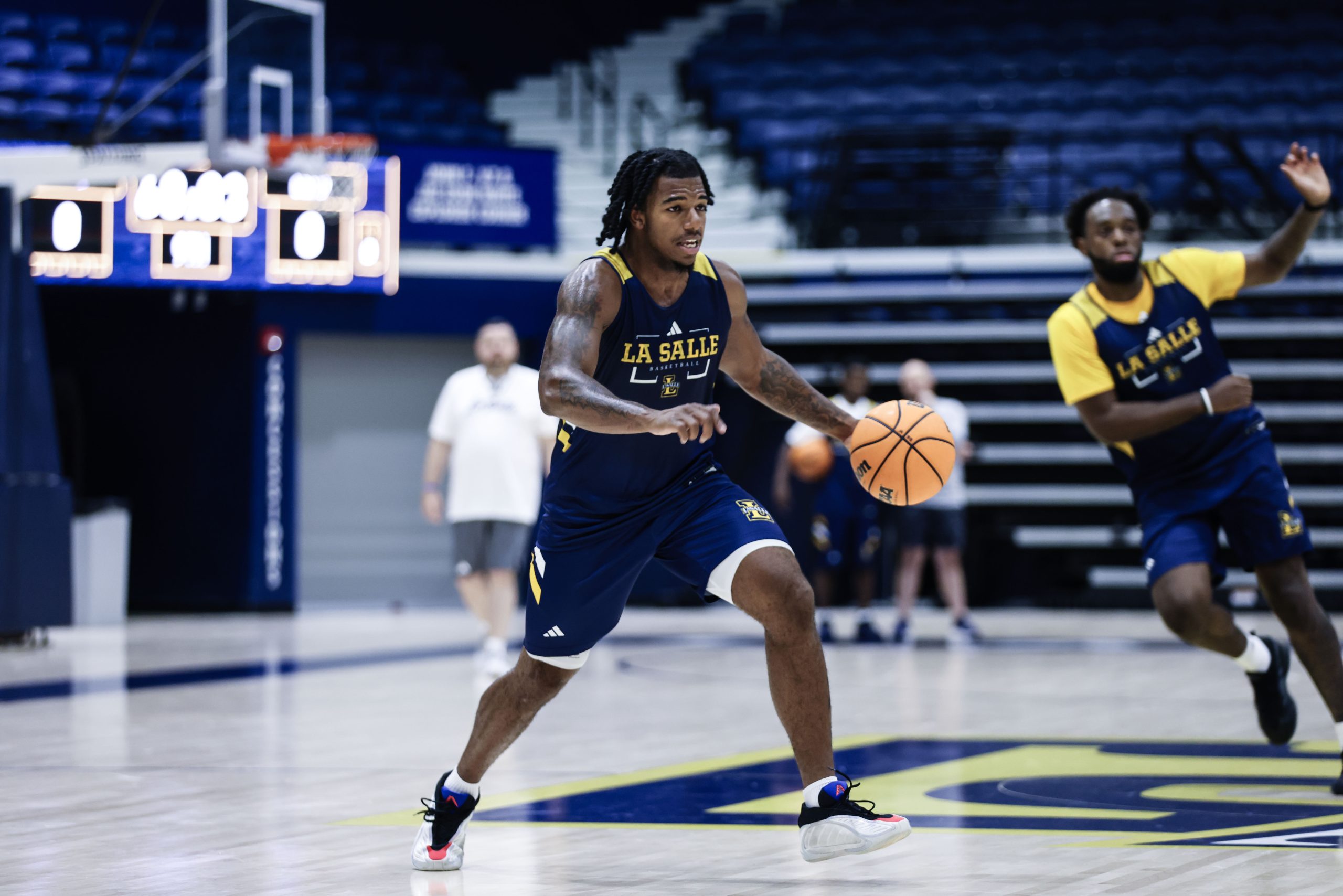
Crossing Broad: Let me ask you a bit about WVU. Obviously I’m biased. But those John Beilein teams were fun to watch, and I think neutrals would agree. Every so often you’re scrolling social media and come across a random college basketball account that says, “Hey, remember the Kevin Pittsnogle era?” And people seem to agree, in the replies, that yeah, those were fun teams to watch. I just thought it was basketball in a pure form. There was motion and tempo. Guys knew how to work and cut without the ball. You played that 1-3-1 zone on defense. What do you think in hindsight now, and did you apply Beilein teachings to your coaching?
Darris Nichols: Yeah and I just talked to him (recently) for about 25 minutes. I think a lot of the stuff we do is kind of a mix of Beilein and (Bob Huggins). I’m not trying to be either one of them, but I’ve taken bits and pieces of what’s made them successful. We put that into our program. The biggest things with those teams that I was on is our team chemistry was unbelievable. It was the type of dudes he recruited. We had the right guys. You look at where a lot of my teammates are now in the game of basketball (Mazzulla, Gansey, etc), they were basketball minds. I think that was the biggest thing, just recruiting guys who really understood the game.
CB: Was it strange for you when Huggs came in for your senior year? He didn’t recruit you.
Nichols: It was strange at first. I thought it was the worst thing ever, playing for two different coaches. Playing for a coach who didn’t recruit me. But looking back now, considering what I’m doing, it’s the best thing ever. I’ve seen it done in two different ways, with two different styles and two different coaching philosophies. Just him coming in and taking care of me after I got hurt, and then coming back and coaching with him (as a grad assistant), not a lot of coaches do that.
CB: You get a little bit of the best of both worlds? You have the high-IQ, smart team basketball that John Beilein taught you, and then the tough-as-nails rebounding team of Huggs.
Nichols: (laughs) Yeah and I feel like this La Salle team we’ve assembled is a mix of both. It’s kind of like this – remember when Beilein left, and Huggs inherited a lot of Beilein players? And then he mixed us with his philosophy. Now you have the toughness with skill.
CB: You had guys that were tough but could also shoot the ball. Da’Sean Butler is a great example. Those types of guys.
Nichols: Yeah, and so I feel like this team is kind of like that. A mix of toughness and shooting.
CB: Was the treadmill story about Huggs true? That he’d put you guys on a treadmill if you messed up?
Nichols: Yeah.
CB: Did he put you on there?
Nichols: I never got on there.
CB: Why would he send guys there? If they were dogging it?
Nichols: If you missed a block out, let somebody straight-line drive on you, turn the ball over. It could be anything.
CB: Did you ever think to bring the treadmill to your teams?
Nichols: We did actually. I had it at Radford. I remember at West Virginia people hated the treadmill so much they were trying to come in late at night and cut the cord and shit (laughs). I told them at Radford, “Hey, you better not break my treadmill.”
CB: I guess as a coach you’re in two mindsets sometimes. I’m sure you’d like to put them on the treadmill. But there’s the counter-philosophy of keeping guys on the floor and letting them live their mistakes and learn from them.
Nichols: I’ve changed. I have a different philosophy than the treadmill. My thing is that we coach the response to the mistake harder than the mistake. Some coaches coach the mistake, like, “That was a horrible mistake,” and then the players don’t know how to respond to anything. If you shoot a corner three and air ball it, then you jog back on defense, for instance. A lot of players would think, “Man, you took me off for the air ball.” But I didn’t take you off for the air ball. I see you shoot air balls every day at practice. I took you off because you jogged back on defense. So I think it lets guys play with a clearer mind.
Kevin has been writing about Philadelphia sports since 2009. He spent seven years in the CBS 3 sports department and started with the Union during the team's 2010 inaugural season. He went to the academic powerhouses of Boyertown High School and West Virginia University. email - k.kinkead@sportradar.com