
Ad Disclosure
The Eagles are Going Nowhere with this Offense

By Tim Reilly
Published:
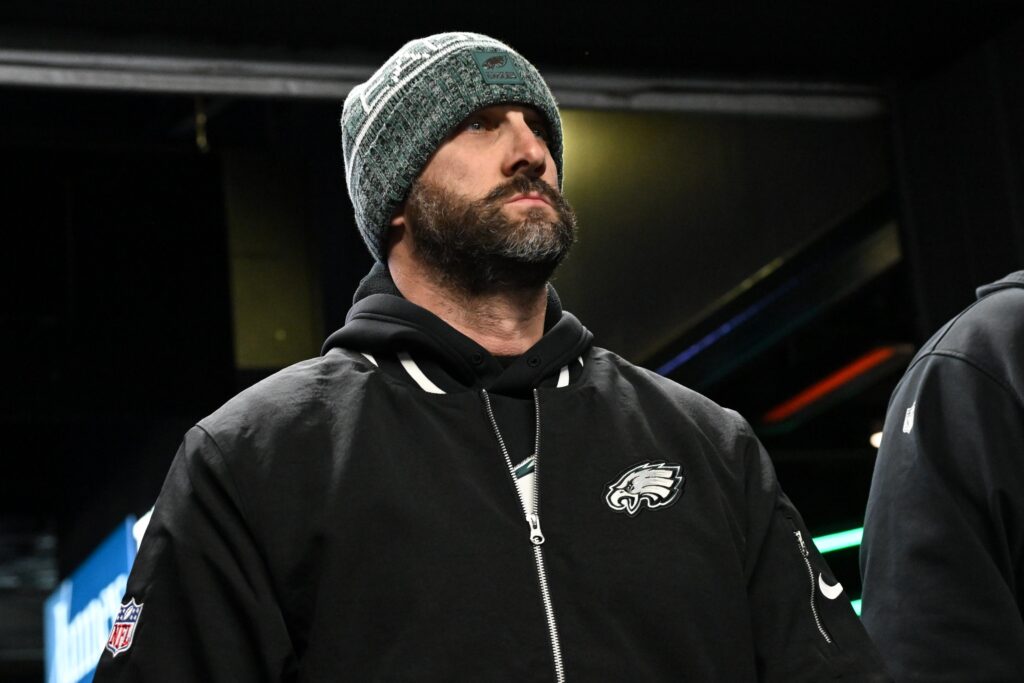
After sixty minutes of football in the unforgiving elements in Buffalo, the destiny of this Eagles season emerged clearer than ever.
The defense remains an elite unit that is playing at the high level required to make a return trip to the Super Bowl. They have consistently shut down, or at least contained, many of the league’s best quarterbacks and most dynamic offenses. Unfortunately, the one offense they can’t control is the one with which they share a sideline. And it’s the maddening mediocrity of that group that will send Philadelphia home early in January. Unless something changes, of course.
After establishing a 13-0 lead against the Bills, the Eagles’ offense promptly shut down its engines once the second half started. Jalen Hurts didn’t complete a pass after halftime. Outside of one first down secured in their first third quarter drive, the Eagles didn’t move the chains the rest of the game. It was four straight three-and-outs when a score, or even an extended series, could have put the game away.
No doubt, the weather in western New York was terrible. As a hard rain fell, I’m sure Nick Sirianni was determined to avoid a costly turnover that would give the Bills a short field and a chance to jump back into the contest.
It’s a noble goal, and an essential element of playing strong, complementary football as the postseason approaches. At some point, however, Sirianni’s offense needs to do its part to secure wins. Get a first down, move the sticks, and milk the clock. Give the defense a chance to rest on the sidelines. Maybe even get a little crazy and score some points.
The critical drive for me came after the Bills finally got on the board with a touchdown. With just over 5 minutes to go in the game and protecting a 13-6 lead, offensive coordinator Kevin Patullo dialed up a toss play that had no chance. An offense that couldn’t get on track handed itself a second and long. A draw for a minimal gain and an incomplete deep ball to DeVonta Smith followed, and then Braden Mann was back on the field to punt.
You can’t call a pitch on a wet field and expect the back to turn the corner and get upfield. It’s the right idea in theory – attack a stacked box with a perimeter run – that takes into account neither the field conditions nor the quality of play the offensive line was providing. Are there no play action calls on the sheet? Anything that introduces some motion or misdirection, that gets the defense thinking and slows them down for just a second? Any answers at all?
The offense has a lot of advantages in today’s game. Penalties are weighted to grant automatic first downs on just about any infraction. Defenders cannot bump receivers after five yards. The bone-crushing hits that used to strike fear in the hearts of receivers running over the middle of the field have been largely outlawed. Quarterbacks have morphed into such a protected class that they can’t be hit too high or too low or landed on too roughly.
The most fundamental benefit the offense enjoys, one that has existed from the beginning, is knowledge. They know what play is coming, and they know when the ball will be snapped. They initiate the action, with the defense only in a position to react. Yes, coverages and blitzes can be disguised, but offenses can get to the line quickly and employ pre-snap shifts and hard counts to provoke the defense into revealing its hand.
Too often, the Eagles waste this advantage. They have been late to break the huddle, leaving little time on the clock to make adjustments or allow Hurts to audible to a better play. Snaps have frequently occurred with just a second or two left on the clock, with guard Tyler Steen tapping center Cam Jurgens in silent count scenarios, which the Eagles used in Buffalo. Defensive linemen and blitzing linebackers have little trouble getting a quick jump.
In the instances when they do give themselves some time, the Eagles are so unimaginative in the ways they use pre-snap motion. It’s just perfunctory, with no real interest in trying to create space for Smith, A.J. Brown, or the underutilized Jahan Dotson to attack.
Where is the creativity? Where is the easy answer schemed up for an offense that just needs a little momentum? The Eagles don’t have it, not this year. Last season, they were able to lean on a dominant offensive line and run game, which masked other deficiencies. The line play has taken a big step backward this year, which has negatively impacted Saquon Barkley’s production. With that security blanket gone, the blandness of this offense has been exposed.
“Winning is hard in this league” is one of Sirianni’s stock answers in postgame press conferences. He said it again as he analyzed his team’s victory in Buffalo, and then later added: “You got to give yourself points for wins and then you got to be . . . super critical of yourself and super critical of how you get better from this.”
Part of that self-examination for the head coach needs to include an honest assessment of how and why he’s employed a conservative approach throughout the season, relying on his defense to carry an offense that features highly-paid players at quarterback, running back, both boundary receivers, and four-fifths of the offensive line. Why aren’t his players meeting the standard on that side of the ball? Can the staff, from the head coach to the coordinator on down, get these players better positioned to succeed?
Because it is hard to win in the NFL. The Eagles’ offense can do a lot more to make it less difficult.
Tim Reilly is a freelance writer from Northeast Philadelphia. He can be reached at reillyt7@gmail.com.