
Ad Disclosure
It’s Time for the Phillies to Treat Bryce Harper Like the Superstar He Is

By Sean Barnard
Published:
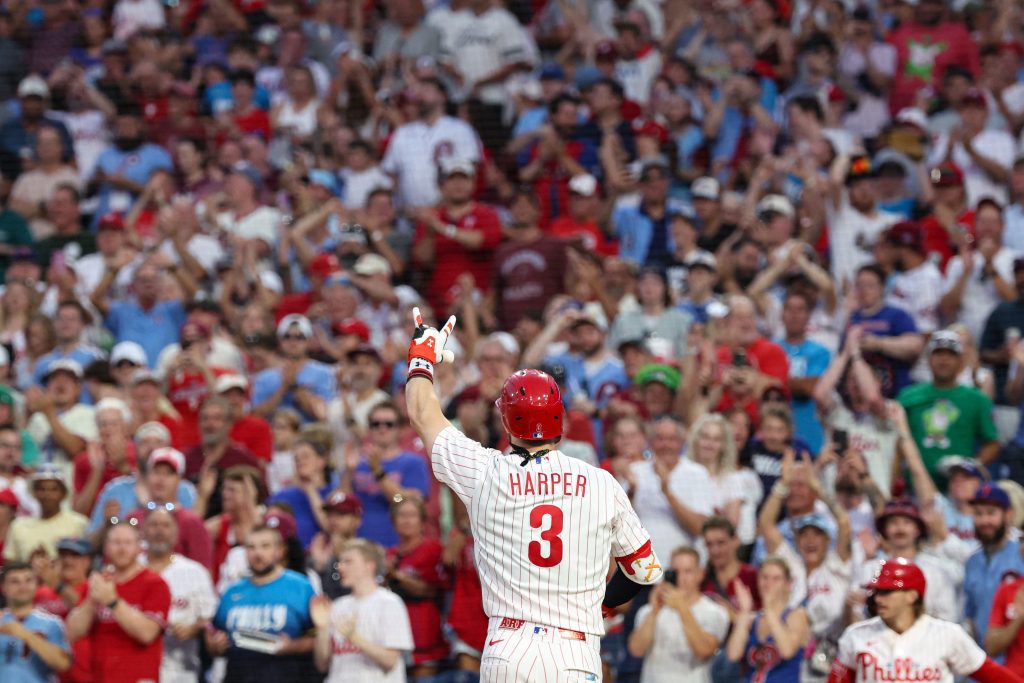
“He’s still a quality player. He’s still an All-Star-caliber player,” Dave Dombrowski said of Bryce Harper during last year’s end-of-season presser. “He didn’t have an elite season like he’s had in the past. I guess we only find out if he becomes elite or he continues to be good.”
There were comments that raised eyebrows at the time among media members in attendance, fans across the Philadelphia region, and certainly Harper himself.
It was less about asking if Dombrowski was right about the subject. The question was why the Phillies President of Baseball Operations would say something like that in this type of setting. What was the desired response in saying this? The two-time MVP was coming off a season in which he slashed .261/.357/.487 with an .844 OPS and tallied 27 home runs and 75 RBIs across his 132 games. It was his lowest batting averaging since 2019, his lowest OPS since 2016, and his 3.1 WAR ranked ninth out of his 15 seasons played. Harper recording just three hits, one of which was a double, across his 15 at-bats in the four-game postseason exit certainly did not help morale heading into this media availability.
Flash forward to the 2026 season, and Harper has had some ups-and-downs as well. The nine-time All-Star has suited up for all 123 games this season, posting slash lines of .253/.373/.495 with an .868 OPS. He has tallied 25 home runs and 72 RBIs, while also posting his best walk rate since 2021. You can get into the semantics of whether this is a “good” or “elite” season, but he has a more legitimate case than anyone on the roster not named Kyle Schwarber for his production at the plate. Harper ranks 13th in MLB in OPS, is tied for the 18th-most home runs, the 20th-most RBIs, and earned an All-Star appearance after being left off the roster last year.
But there has felt to be a change in the organizational management of Harper.
When he signed his 13-year-contract for $330 million with the Phillies, there was a comforting finality. There were no opt-outs, he received a full no-trade clause, and this was a deal that gave Harper the most guaranteed money of any MLB player at the time. He became the foundation of the Phillies franchise, and the solar system that all decisions revolved around.
The Phillies have fallen a bit into the same trap that the Sixers found themselves in before this star-studded offseason. The novelty of postseason opportunities has run its course, and there was a collective feeling among the fan base to wake them when the team is back in the World Series. We have seen this Phillies team fall short of the postseason aspirations in a variety of ways, and frankly it is impossible to argue that the franchise has taken steps closer since snapping their 10-year postseason drought in 2022.
But it also should not be ignored how much of the responsibility Harper deserves for changing this level of standard. Gone are the days of Maikel Franco, Odubel Herrera, and Scott Kingery. Instead, roster decisions are made around All-Star players like Trea Turner and Luis Arraez.
Harper has consistently mentioned, oftentimes by his own offering, that he will do whatever it takes to give the team their best chance at winning a World Series. This includes playing whatever position is asked of him.
But just a few days before the MLB trade deadline came and went, marking the Phillies’ last chance to upgrade the current roster, it was Harper’s turn to challenge the front office by calling for reinforcements:
Second baseman Arraez was the headline addition, even if the prevailing feeling that more should have been done still leaves a sour taste. But Arraez brings a style of play the team did not have, and a necessary contrast in this lineup. The three-time batting title winner has tallied just 107 total strikeouts since the start of the 2023 MLB season. This figure is fewer than Schwarber, Turner, Marsh, and Harper have tallied in just this season. His contact-first mindset provides a new flavor to the oftentimes all-or-nothing collective approach by the Phillies, and Arraez was the best bat moved across the league at the deadline this year.
But along with bringing Arraez’s bat into the lineup, you must slot him into the field. It was made clear leading up to the deadline that Arraez had no interest in playing any position outside of second base as his name became more frequent in trade talks. Throughout his career, he’s logged 472 appearances at second base, 263 at first base, 80 at third-base, eight at shortstop, and 48 in left-field. Arraez played 103 of his 104 games at second base with the Giants before the trade deadline.
The Phillies went with continuity by keeping their new clean-up hitter at second base. But to make this possible, it involved a larger infield shake-up than is remotely the norm, or that I can find any precedent for at this stage of the season for a hopeful contender. Bryson Stott hopped across the diamond from second base to third base and has more than looked the part in fielding his position. Alec Bohm transitioned from third base to first base, where he has made 146 starts in his career and as many as 80 in a season, although there have been more growing pains with his defensive performance. This forced Harper to transition from first base back to right field, where he last had suited up for eight games in the 2022 season, before he suffered a torn UCL and was forced to be the designated hitter for the reminder of the season due to his inability to throw.
There is no question that Harper is still capable of playing the outfield. In fact, it feels pretty clear that he is a defensive upgrade from many of the names that had been given chances at the position this year. But are the potential short-term benefits of attempting to make this work worth the long-term risks that come with the position change?
Harper has always played an aggressive style of baseball that is endearing when it is going well and frustrating when it is not. He will consistently attempt to stretch a single into a double when he probably shouldn’t, look to steal a base when he feels the pitcher is not giving him the necessary attention, and run through a fence to save an out if he feels the situation calls for it. Any organization would much rather step in to scale down their star’s effort level than the other way around, but Harper is the type of star that sometimes requires being saved from himself.
This is especially the case considering Harper is already dealing with a lingering knee issue which has not been given nearly enough attention. There are some nights where it stands out in his stance at the plate or trips around the base path more than others, but the effort to downplay it has been pretty evident.
“I was not feeling it,” Harper told The Athletic following Tuesday’s 2-0 loss to the Cardinals. “But the more I’ve ramped it up, I’ve gotten sore. I think the more I play, I think it’ll help me — just getting in condition more. I feel like I’m in spring training again, trying to get through everything. The more I play, the more my body is accustomed to playing the outfield, I think it’ll kind of weasel its way out.”
Maybe Harper’s glass-half-full perspective will come true, and the knee problems will be a non-issue. But he elaborated that the pain mostly pops up when he is forced to stop and start or move suddenly, all of which are much more frequent when he is asked to play the outfield. The entire thought process behind moving him to first base, which he is now plenty more than serviceable defensively at, was to extend his career and limit wear-and-tear on his body.
The creativity shown to bring in Arraez and provide a new jolt to this Phillies lineup deserves praise. But the acceptance that the only way for this to be possible was to move Harper to the outfield is just untrue.
The lone member of the infield that did not see his positional responsibilities shift was Trea Turner. Both Dombrowski and Don Mattingly made it clear that there was no consideration to move Turner from shortstop when speaking with the media following the deal. Whether this was a refusal to go back on some sort of handshake agreement that Turner would be the organization’s shortstop for the duration of the contract, or an ignorance to the consistent basis that he has been harmful in the field are both unacceptable. Turner has been the defensive weak spot on this Phillies team for plenty of his contract, and certainly this season. Even while benefitting from a few regrades throughout the ebbs and flows of the season, Turner is tied for second in all of baseball for the most errors in the league.
But if Turner is considered landlocked at shortstop and the Phillies did not want to put him in this reshuffle, why is Alec Bohm’s bat viewed as a necessity at this stage of the year? The soon-to-be free agent is posting career-worst marks in just about every notable offensive stat. There isn’t really a statistical argument of him being more impactful than what the Phillies have gotten from Derek Hill this year, and even if Hill fades closer to the norm of his career, this is largely the production that is currently being seen from Bohm at the plate. Was it not at least worth a shot to move Stott to third, keep Turner at shortstop, Harper at first, and plug Arraez in at second-base – at least in certain matchups?
It’s admirable the way Harper is willing to be malleable in his role in a way that very few stars are this deep into their careers. But just because he will doesn’t mean he should. Harper is largely delivering at the plate and fielding his position to the best of his abilities, regardless of where this is. Keeping him in situations that limit his chances of injury and the need to play through knee pain would play a much larger role in helping Harper return to his elite offensive level than publicly challenging him through the media.
Winning a World Series is extremely difficult. This is especially the case when there are nights where the back-to-back champion Dodgers look completely unbeatable. But if the Phillies are to get over this championship hump, it is going to involve Harper playing a major role. Even if he is not the MVP-caliber player he once was, Harper is a tone-setter for the roster and still has a legitimate case for the best pure hitter on the team. It felt this offseason was a bit of a pivot point for the way Harper is being treated, and the effects of this may be a bit deeper than has been fully recognized.
Sean Barnard has covered the Philadelphia 76ers and general Philly Sports for over six years in a variety of roles and for multiple outlets. Currently works as a Content Writer for DraftKings Network, Sixers/NBA Insider for Philadelphia's Fox Sports the Gambler, and co-host of Sixers & Phillies Digest on Youtube. Forever Trusting the Process.