
Ad Disclosure
Some Thoughts on John Cena’s Last Match and the Wrestling Industry Today

By Nick Piccone
Published:
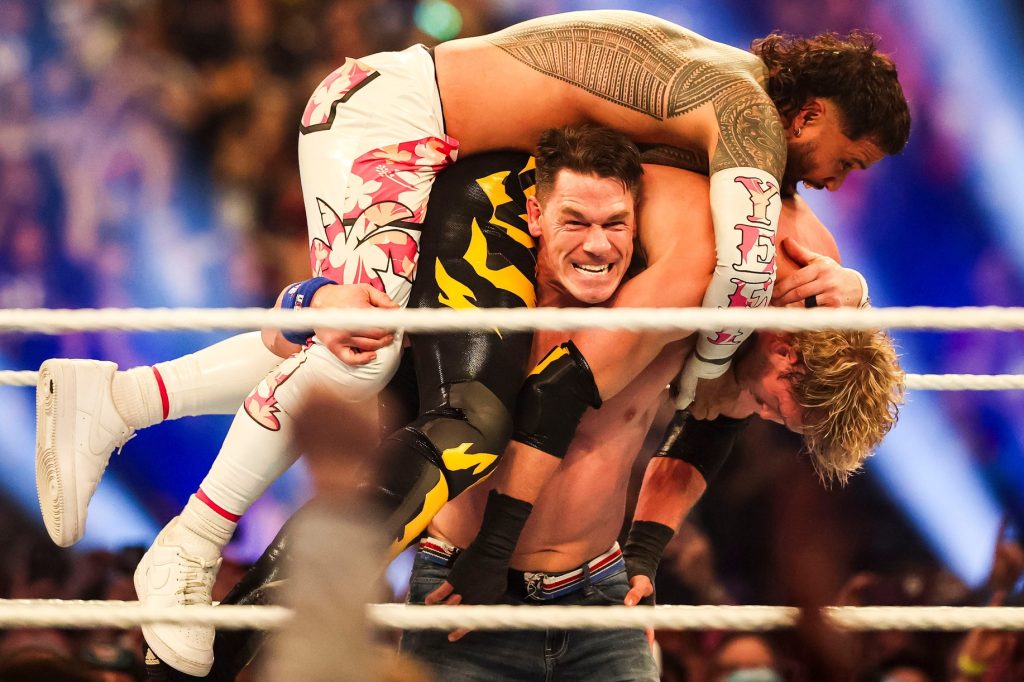
John Cena wrestled his last match this past Saturday in Washington, D.C. against one of WWE’s top heels in Gunther. After debuting in June of 2002 against Kurt Angle on an episode of SmackDown!, Cena carried WWE on his back for more than a decade before eventually becoming a part-time performer and officially calling 2025 the last year of his in-ring career. Seventeen World Titles highlight his many career accomplishments in wrestling, and there most likely won’t be anyone who will surpass that number any time soon.
The Cena Retirement Tour was hit and miss this year – mostly miss. It started off terribly, and they tried to pivot in August when Cena inexplicably turned babyface two nights before his WrestleMania rematch with Cody Rhodes during Night 2 of SummerSlam. It was an enjoyable match, certainly up for Match of the Year consideration. It was the highlight of Cena’s year.
A token run with the Intercontinental Championship before dropping it right back to Dom Mysterio was a fun little wrinkle, but it didn’t mean much in the grand scheme of things. Not much Cena did this year felt “big.” He had some great matches, but was often haunted by the lack of follow up to what happened in February at Elimination Chamber and the much-less entertaining WWE product in general. People thought they could at least rely on Cena as the overall product took a nosedive in 2025, but they couldn’t.
A lot of people tried to put that all behind them Saturday night. Admittedly, Cena wasn’t “my guy” growing up. I started watching wrestling in 1990, so when I had the likes of Hulk Hogan and the Ultimate Warrior to idolize, it seems very different than having someone like Cena. Cena felt more relatable to the everyday person, and that might be what eventually turned the crowd against him in late 2005. It was then that the most vocal people in the crowd decided to reject Vince McMahon’s chosen one of the era. In the Attitude Era, there was a simple fix – turn him heel. But that wasn’t in the cards for Cena. In fact, it’d take an entire decade for people to come around on him as an in-ring performer, notably when Kevin Owens was called up from NXT as NXT Champion and made an impact immediately with Cena. Cena then tried some new things inside the ring, because what did he have to lose? He was gaining the respect of people that hated him (including me).
I didn’t always have a good reason for not liking Cena. I didn’t think he was a good wrestler inside the ring, but I didn’t care about that with Hogan or Warrior. Funny, right? Cena played it safe. Did what worked. The same stuff Hogan and Warrior did. So why did I love watching them, but hate watching Cena?
Well, age, for one. I was older when Cena arrived, and knew more about the behind-the-scenes aspect of the wrestling business. I knew there was a concerted effort to make Cena the face of the company, but at the time, I was all in on Batista. I thought he had a better career arc as a member of Evolution, eventually turning on Triple H after figuring out he was being used and had some great matches with him and others on the Raw roster before switching brands with Cena. I don’t know if it was a lack of trust in Batista or the fact Cena was eight years younger so it made more sense to strap the rocket to his back, but I always held a slight grudge against Cena because of that. It wasn’t until 2015 where that lifted a bit because Batista was long out of the picture and there was nobody else WWE really trusted to be the face. Cena’s matches inside the ring became better in terms of looking different than the “same old Cena slop” I used to call it, because he was taking more chances, and as a wrestling fan, I appreciated that.
Fast forward to Saturday, and the finish of his last match was polarizing to say the least. Many people hated it, many people loved it. Tapping out to a “choke” hold after unsuccessfully trying to counter it for a few minutes seems like a great ending to a character. I guess it’s all about how it’s presented. Cena’s mantra has been “Never Give Up,” so wouldn’t it have made a little more sense to just have him not give up as he loses consciousness? I think that’s the easier, better, most impactful way to go especially when there are kids today who didn’t even grow up with Cena during his prime, but know him from movies and TV shows. Never give up… except this one time. Notably, it wasn’t the first time Cena’s ever submitted, but the last time he did so was February 2004 in Kurt Angle’s ankle lock. So, yeah, it’d been a while.
The reaction inside the arena and especially around Triple H during the post show was not kind. Chants of “AEW!” surrounding him, minutes after he was booed as he embraced Cena inside the ring. Supporters of the finish said Gunther would have tremendous heat on him and would make him – despite already being made even before he was the last match for Goldberg earlier this year. There were videos around social media showing fans yelling and even throwing some objects at Gunther as he left the arena. This is what happened often in the 70s and 80s when wrestling was still real, damn it! And while I understand the thought process, I just don’t share in it. The heat isn’t on Gunther. It’s on Triple H, WWE, and might even be on Cena himself. The fans didn’t want to see him lose. That was as lively a WWE crowd as we’ve seen recently. An audible isn’t the worst thing to call there because we aren’t stuck in the 1970s or 80s anymore.
And that’s the biggest issue I have with all this discourse surrounding the end of Cena’s career. Triple H mentioned in his postshow interview the time-honored tradition of losing on your way out. What happened in the 50s happened in the 60s happened in the 70s happened in the 80s happened in the 90s. But over in AEW, Sting won his last match in 2024. Stone Cold Steve Austin technically won his last match against Kevin Owens at WrestleMania in 2022. It has a place in wrestling today. But with that comes the positives and negatives.
I’ve watched professional wrestling go through a lot of changes since I was five years old. As much as I hate to be “that guy” when it comes to wrestling, I think I’m as knowledgeable as anybody in discussing it. I’ve consumed years of wrestling content dating back to the 60s – hell, I even have some tapes from the 50s in my collection. I first got the internet in 1998 right after WrestleMania 14 – and reading about the business became so interesting to me. Imagine my surprise when I found out the Repo Man was the same guy as Smash from Demolition! Mind blown.
There are times when reading reports about what’s going on behind-the-scenes makes what we’re watching on our screens better. There are also times it makes it worse. I don’t understand the positive of watching something happen that one might not like and immediately thinking “they buried him” or “he doesn’t deserve the title” when we’re all just watching it the same way we consume other forms of entertainment. I don’t watch a movie and think to myself, “I would’ve written a better line for that character.” I know wrestling has its differences in that entertainment realm, but overall it’s consumed similarly to the way movies, sitcoms, and even documentaries are. It’s an art form that doesn’t hide that it isn’t real anymore. If someone thinks a guy shouldn’t be champion just because he moves merchandise, that’s fine, but it doesn’t really take into account anything on the business side. If we want to be so up-to-date on what’s going on behind the scenes, that’s the price we pay for wrestling companies making decisions we don’t personally like. We can always stop watching. I’ve said before on the Straight Shooters podcast I’ve taken multiple sabbaticals from my consumption of wrestling during the course of my fandom. I feel like that’s helped me continue appreciating the art form while constructively criticizing what could be better and what’s working.
We also have to remember how different pro wrestling as an art form is today. It isn’t, nor should it act like, it’s in the 80s or 90s. WWE exposed how the business works even before buying WCW, so the industry was going to change even if WWE wasn’t the only mainstream option for almost 20 years. TNA could have had a run, but they fumbled more than Brett Favre. Deep down, fans want to be in the know of everything so they can form opinions, even if they’re not expert opinions. That causes so much of the wrestling conversation on social media platforms to be as toxic as ever, especially when we now have two mainstream options to consume. YouTube and other platforms also make it easier to consume wrestling content today than we had in the 90s. Wrestling is different today.
That brings me back to Cena tapping out. I absolutely think Cena losing is the right decision. The “time-honored tradition” can sometimes be a good one in wrestling, but it’s also a crutch in 2025. There is always a margin of error where other outcomes are acceptable. Cena losing, but not tapping out, was the best way for his character to go out. Telling everyone to not give up for 20 years and then give up with a smile on your face doesn’t quite feel the same. If you’re in a “choke” for that long, wouldn’t you pass out anyway? Would you have your wits about you smile and have the last 20+ years in that ring flash through your head and tap? I would have even bought a smile and him zonking out. That’s what made the Cena character great. That’s what people were invested in. And, like much of 2025, they swung and missed. Just because it may have been what Cena wanted doesn’t make it a gift to the wrestling business.
Guys like Triple H want to protect the business as much as possible after having a huge hand in exposing it from when he was an active wrestler to now. You can’t put the toothpaste back in the tube, no matter how many toothpicks you use.
Nick Piccone has covered Philly sports and events for over 14 years with various outlets, including PhillyVoice and Philly Influencer. In 2015, he co-launched the Straight Shooters Wrestling Podcast. He's also a producer for Fox Sports Radio Philadelphia and the Villanova Sports Radio Network. He grew up in South Philadelphia and South Jersey, and is a graduate of Neumann University. Contact: picconenick@gmail.com