
Ad Disclosure
How Can Jared McCain’s Immediate Thunder Success be Seen as Anything but an Indictment on the Sixers Organization?

By Sean Barnard
Published:
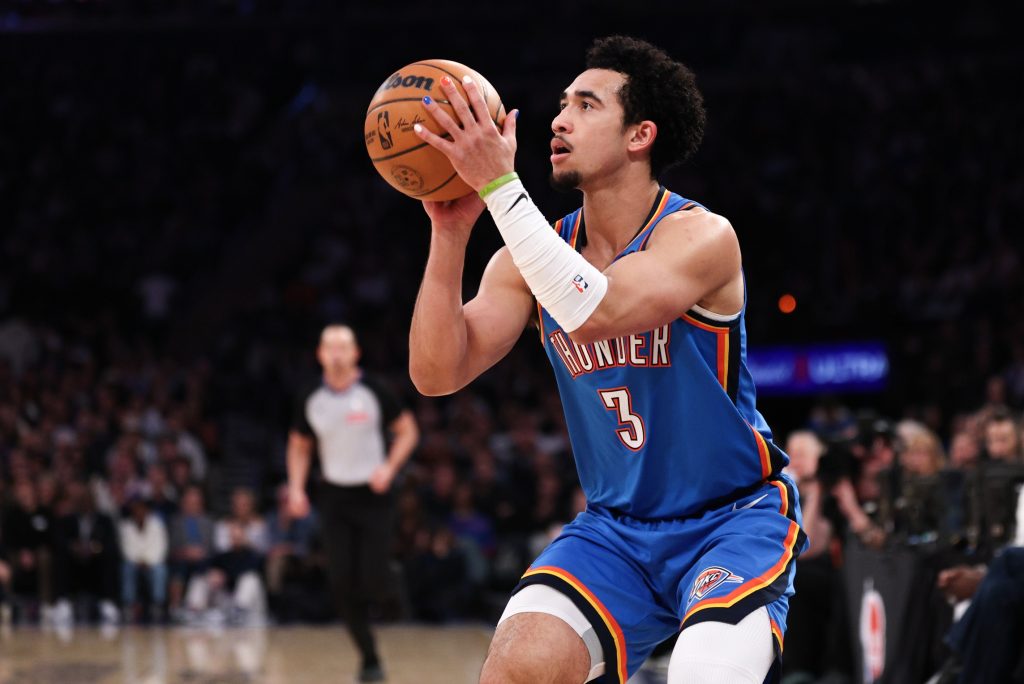
It’s been quite a while since the Sixers fan base experienced such a widespread outcry of frustration as the one brought on by the decision to trade Jared McCain at the deadline. One month removed from the decision, it’s clear why this frustration arose.
McCain has suited up for 12 Thunder games, clocking 19.5 minutes per while posting averages of 11.9 points and 2.8 rebounds. He’s shooting 41.1% on 4.7 three-point attempts per game. He’s scored double digit points in eight of the 12 games and 20+ in three of them.
This comes after he spent his first 37 games with the Sixers, returning from injury. Across these opportunities, he logged 16.8 minutes per game and posted averages of 6.6 points, 2.0 rebounds, and 1.7 assists. McCain shot just 37.8% on his 3.2 perimeter shots per game and just 38.5% from the floor overall.
It should be pointed out that McCain failed to look like the best version of himself after a rookie season in which he popped off the page. He looked like a Rookie of the Year frontrunner before the knee injury, shooting 46% from the floor and 38.3% from three.
This was a small sample size that occurred while most of the Sixers’ key players were already sidelined due to injury. There was no clear answer for how he can fit with the higher contract players and key members of this team. It’s also worth noting that there are fair reasons for his struggles at the start of the year. McCain’s promising rookie season ended due to a meniscus tear, and then he suffered a torn UCL in the thumb of his shooting hand right at the start of training camp. From a health perspective, it was going to take some time for him to play his way back to full strength. From a role perspective, it is also a difficult challenge for McCain to be sidelined as the team attempted to their identity at close to full strength as they established the playbook and chemistry with each other.
However, this has not looked to be a problem in Oklahoma City.
Daryl Morey’s Decision to Make the Trade
Plenty of immediate takeaways pointed to the Sixers’ commitment to ducking the luxury tax as the driving force of the decision. While the willingness to dip into the tax is worth a conversation, the decision to salary dump Eric Gordon following the trade, and comments made by Daryl Morey after the fact, make it increasingly clear that this was not the motivation behind the McCain deal.
Morey’s calculus was that there are legitimate questions about McCain’s long-term fit, and the value in this trade’s return satisfied him. Tyrese Maxey has become a face of the franchise was Joel Embiid’s career wanes, and he’s taken notable strides in his individual development every season. For all that he brings to the table from an offensive standpoint, there are roster adjustments that must be made around Maxey to maximize this team. V.J. Edgecombe has been a hand-in-glove fit next to Maxey in the backcourt, and his defensive-minded skillset is a necessary balance. It’s become increasingly clear that this is the Sixers’ backcourt of the future, which could do some pretty special things for years to come. McCain became the odd man out.
Morey also made it clear that this was a trade package he viewed with high regard. Officially, the Sixers brought back the Houston Rockets’ first-round pick for this season, a 2028 second round pick (most favorable of OKC/HOU/IND/MIA), a 2028 second-round pick from the Milwaukee Bucks, and a 2028 second-round pick from the Thunder. One first-round pick and three seconds is a solid stick value, but the Rockets’ pick currently projects to be the 25th overall pick in this year’s draft and second-round picks essentially translate as lottery tickets or trade throw-ins. When asked about the common critique of “selling low” on McCain’s current value, Morey pushed back during his post-trade-deadline media availability:
“I am quite confident we’re selling high. Obviously, time will tell, but the only other high point–and we weren’t looking to sell. I’ll be frank, like teams came to us with aggressive offers for him, and you could say, ‘Yeah, that’s because he’s a good player.’ I agree with that. We thought this return was above for the future value for a franchise with what we could get. So, the only higher point would have been during his run last season, but otherwise, we feel like we did time this well.”
Another point made clear by Morey was that this deal was done with the intention of flipping these draft picks for a player who could help the team this season. The McCain trade was broken by ESPN’s Shams Charania at 1:58 on February 4th, 25 hours until the trade deadline officially passed.
Perhaps the larger crime was the inaction beyond this. If these draft picks were successfully flipped for a player that filled a hole on this current team, the tone would likely be much different. But it’s a results-based world we live in, and the bottom line is this did not materialize. What we’re judging is the Sixers shipping off McCain and Gordon without bringing back a player, outside of signing Cam Payne from overseas and upgrading Jabari Walker to a standard contract.
It’s also fair to push back on the thought that the Sixers did not go all-in. Regardless of what trade is or isn’t made at the deadline, the outlook is still fully dependent on what level of health Joel Embiid and Paul George will bring to the postseason. This is the case regardless of what deal was or wasn’t made. For as much talk as there has been about the Eastern Conference being wide open, was there a trade out there would have allowed the Sixers to jump the Detroit Pistons, New York Knicks, Boston Celtics, or Cleveland Cavaliers?
It was extremely encouraging to see an increased level of fight and pride from this Sixers team to start the season. No longer was the game-by-game outlook dependent on if Embiid was available. There were tangible steps made to win games without the former MVP and a change in overall identity. But the more the season has gone on, the more this has dissipated. Just months removed from this resilient trait being such a positive, the Sixers have become the first team in NBA history to lose at home by 40+ points three times in the same season. This is feat that even the prime Process team could not accomplish.
Nick Nurse’s Inability to Maximize Jared McCain
Nick Nurse had a difficult challenge in managing McCain directly. The clear goal that Nurse wanted to accomplish in the early part of this season was to establish a culture of competitiveness and undo some of the damage that was done during last year’s disaster. The Sixers were not bad enough to justify playing McCain when he was not at a level that was helping the team. However, they also were not good enough to the point where the reward of sticking with McCain would not have been worth it.
The job of a head coach is to maximize the talents of the players he has on the roster. It does not take a keen basketball eye to note that McCain is not stylistically the type of player that Nurse has had the most success with in his career. At his core, the Sixers’ head coach is a defensive-minded basketball brain who has had his greatest success leaning on lengthy, athletic wings that can wreak havoc defensively. The Toronto Raptors’ 2018-19 championship team, headlined by Kawhi Leonard, was a prime example of this.
But there has been some crystal clear difference in the usage of McCain in Oklahoma City than was the case in Philadelphia this year. His defining NBA skill will be his ability as a shooter and off-ball relocation instincts. The Thunder have made a clear effort to run pin-downs and get him moving:
In contrast, so much of McCain’s year two suggested mental struggles for what exactly his role was. He got a quick hook when the minutes were not going well. McCain was also a bit trigger happy in times he was on the floor, which is represented in his disappointing efficiency splits. Whether it was his shooting touch not fully returning or the shot selection being a problem, he was not the efficient offensive threat the Sixers hoped and saw last season.
There has been plenty of pushback suggesting that McCain’s gaudy numbers are only occurring due to the injuries the Thunder are dealing with. While there is some truth baked in here, McCain has hit some big shots in big moments playing alongside Shai Gilgeous-Alexander and the other stars:
Also, the Sixers have never had to play without their star player before right?
A Quentin Grimes Problem
One significant side effect of the McCain trade is how Quentin Grimes has now become essential to this Sixers team. A bit similar to McCain, Grimes was a midseason addition last year and played the best basketball of his career in what amounted to a wasted season. In the bleakest stages, Grimes was the lone bright spot and the complete offensive engine. Across 28 games, he averaged 21.9 points, 5.2 rebounds, and 4.5 assists while shooting 37.3% from three.
This past offseason looked to be Grimes’ path to his biggest NBA payday as he went through restricted free agency. But negotiations hit a stalemate as the Houston product reportedly demanded a major raise to the point where the Sixers were right to blink. The end result was him playing this season on a one-year qualifying offer worth $8.7 million, and the two sides will return to the table this offseason.
The biggest problem, like McCain, is that Grimes has struggled to be the consistent offensive option the Sixers need him to be this year. With Maxey and Edgecombe holding down the starting guard spots, Grimes is the third man in the rotation and expected to be instant offense off the bench. Through 56 games, Grimes is averaging 12.5 points, 3.6 rebounds, and 3.4 assists while playing 29.5 minutes per. He has not scored 20+ points in a game since December 5th, and has been held to 10 or fewer in 23 of his 56.
Grimes has scored 97 points since the McCain trade. McCain has 143 points for the Thunder, and is third in the entire NBA in bench points, trailing only Bennedict Mathurin and Payton Pritchard.
Morey was open about the Sixers’ desire to re-sign Grimes this offseason. But following the McCain trade, this has become a necessity instead of a luxury. In theory, if Grimes’ camp is to return with a desire for a contract that the Sixers would be hesitant to hand out, they could have allowed him to walk and given McCain another opportunity as he continues to play out a cost-controlled rookie deal. Instead, there is no true backup plan on this current roster, and the team will have to get innovative in the offseason to replace him.
Grimes is still a solid player worth having in the rotation. But the leverage has shifted in his favor in a way that is not ideal for the organization. If he can be the best version of himself at a constant rate, the need for him on this Sixers team is clear. They desperately need him to find some stability in this final stretch.
It’s not fair to connect this recent Sixers’ rough stretch to the McCain trade. The reality is, he was not making or breaking this season, given Nurse’s rotation and what his role is. But there is still a human element to sports. Beyond just McCain being a positive locker room presence and well liked by teammates, the message that no reinforcements were coming was received loud and clear.
Maxey was asked, after the Spurs blowout, if he believes there has been a slip in morale following the trade deadline. From Ky Carlin at Sixers Wire:
“Maybe a little bit. We just won three straight games, though. So, it’s like, I ain’t about to, like, harp on it too bad. It was tough. We lost however many straight. Then we won three straight. Now we’ve lost two straight. I mean, it’s the NBA. I mean, it is what it is. It’s hard, definitely. Trade deadline was difficult, and it’s life, but we moved on from it, and that’s something that we have to put in our rear view mirror. If we’re gonna sit there and dwell on the trade deadline, now, I think that was three, four weeks ago. I mean, however long ago it was. That ain’t gonna get us nowhere.”
The Sixers seemingly hit a slam-dunk when they selected McCain 16th overall in last year’s draft. He outperformed all realistic expectations and had plenty to build from. It felt a premature time to hit the punt button on the rest of his career, given the uncertainty beyond this season. The Sixers have some interesting decisions to make for the future, and they closed off an avenue of possible success by making this deal.
There have certainly been some overreactions to the McCain trade among Sixers fans. But the reality is the Thunder have already discovered a clearer blueprint to maximize his skillset, and the Sixers will be hoping to use these draft picks to select a player in the ballpark of McCain’s talent. Morey deserves credit for his strong draft success, but this is a high bar he has set for himself to clear. The Sixers made the gamble that what McCain showed in his first season was not real and that the draft picks better served them for the future. But giving up on promising young talent with an unclear direction for the future feels like bad business, anyway you slice it.
The decision has been made, and the fan base must move on with whatever McCain and the team’s future will be. But the lack of a clear short-term benefit from this deal makes it tough not to view this as one they will regret. As Morey said himself, only time will tell.
Sean Barnard has covered the Philadelphia 76ers and general Philly Sports for over six years in a variety of roles and for multiple outlets. Currently works as a Content Writer for DraftKings Network, Sixers/NBA Insider for Philadelphia's Fox Sports the Gambler, and co-host of Sixers & Phillies Digest on Youtube. Forever Trusting the Process.