
Ad Disclosure
The Future of Joel Embiid and the Sixers Cannot Be Decided on Emotion

By Sean Barnard
Published:
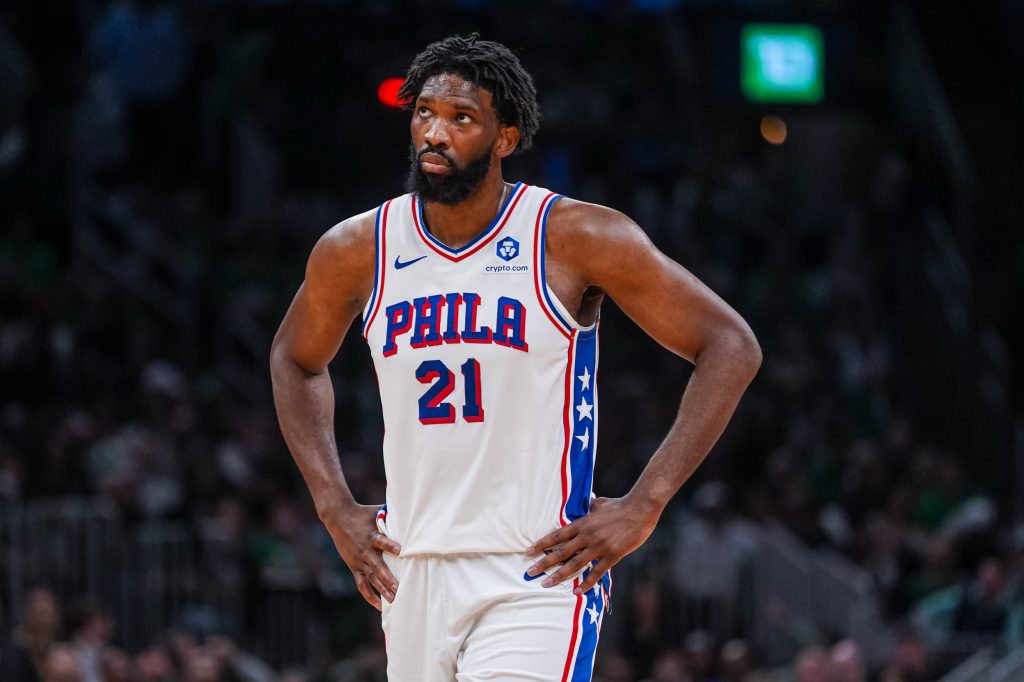
There are more questions than answers about the future of the Philadelphia 76ers.
The organization has made the playoffs in eight of the past nine years, yet has failed to advance past the ever-elusive second round. Joel Embiid and company overcame some playoff demons in 2026 by finally defeating the Boston Celtics, but this achievement will likely be overshadowed by their largely embarrassing four-game sweep at the hands of the New York Knicks.
For the first time in the Embiid era, there seems to be some legitimate friction between the star player and the front office. How much of this was directly tied to his relationship with Daryl Morey, and how much of these feelings are more deep-seated is still to be determined. The former MVP has never been shy to speak his mind and has sent more than veiled shots at the front office throughout the second half of the year. This largely stemmed from Embiid’s public plea for the organization not to prioritize “ducking the tax” – only for the organization to ship out Jared McCain for draft picks and not return a single player.
Shortly after the disappointing trade deadline, Embiid got in a social media spat after being ruled out for a matchup with the Wizards – which he says he found out about online – and the star’s decision to not answer questions about management spoke volumes.
Neither Embiid nor the organization has been blameless in the team’s inability to reach its desired level of postseason success. Embiid has suited up for just 490 regular-season games and 66 postseason games in his career. His injury issues and lack of consistent availability have been problematic, and there are plenty of fair gripes about the poor decision-making that have limited the potential for postseason success with the roster around him.
But for the first time in this era, there seems to be a crossroads. Philadelphia has quietly laid the foundation for life after Embiid, with Tyrese Maxey and V.J. Edgecombe at the forefront of this conversation. However, this does not change the three year, $187.9 million extension that Morey signed the former MVP to, which is set to begin this season. So what can the Sixers do?
The ‘Trade Embiid’ Argument:
There is a feeling of apathy amongst the larger fan base. The recent mindset of “Wake me up when the playoffs start,” has largely shifted to overall disinterest. We have seen plenty of iterations of the Embiid-centric rosters, none of which have produced the desired results from a franchise perspective.
When he is at his best, Embiid is still on the short list of most talented players in the league. Even a diminished version of the two-time scoring champion can comfortably look like the best player on the floor in nearly every matchup he faces. Just 17 days after his emergency appendectomy surgery, Embiid averaged 24 points, 7.3 rebounds, and 5.4 assists across the postseason. The Sixers would not have beaten the Celtics without Embiid carving up a vulnerable Celtics interior defense in a way they had no answer for.
At the same time, Joel’s defense has slipped, and his inconsistent availability has proven increasingly problematic. Across the past three seasons, he has played a total of just 96 regular season games. Due to a mix of bad luck and his typical injuries, he has never been at his physical best in the postseason.
Life after Embiid looked daunting for plenty of years, but for the first time in the last decade-plus, you can talk yourself into the vision. The biggest appeal of moving on from Embiid is largely symbolic. The Sixers have already made a clear effort as an organization to begin pushing Maxey as the face of the franchise, dating back to the start of the season. While the inconsistent availability is a hurdle for the team, it has also given Maxey and the rest of the team the chance to grow without him.
Is Embiid’s presence too much of a distraction for the organization’s young pieces to grow as necessary? There have been plenty of rumblings of frustrations from a variety of places, and a few deep dive reports to distribute the blame should be expected in the coming weeks. It is completely fair to assess that the Sixers play a notably different style when Embiid is on the floor versus when he is missing time. There is also now a six-year sample size of Maxey playing next to Embiid, and it is abundantly clear that his production and efficiency are better when he is sharing the floor with Embiid and not the top name on opponents’ scouting reports.
Maybe Maxey cannot truly scale up as the franchise player while Embiid is still here. Maybe all of the cultural critiques of the franchise stem from Embiid’s being allowed to play by different rules. Maybe removing his presence is the only way to substantially change this. But any way you slice it, the decision to move on from the Embiid era is driven more by the symbolism of what this means than by a desire to get the franchise closer to championship aspirations.
Why Trading Embiid is Such a Difficult Ask:
To start with, all the reasons that were brought up for why it makes sense to move on from Embiid are ones that other organizations are well aware of. You aren’t going to catch another NBA team off guard by his injury concerns and the consistency issues that come with this.
Beyond this, the NBA trade rules and dollar figure attached to Embiid’s name are significant hurdles to clear. Embiid’s extension hasn’t even kicked in yet, and he holds a $67.2 million player option for 2028-29 that will travel along with him in any potential deal.
The new CBA is already showing its effects across the league, too, with cost-controlled contracts becoming more valuable than ever before. Teams are forced to work under different rules depending on where they fall on the salary cap spectrum, with first apron and second apron limitations being phrases you should become familiar with if moving Embiid is a path that you truly want to explore. Even without these complications, the trade return has to be in the ballpark of the same contract value to be legal under NBA rules.
Any way you cut it, the Sixers are not “winning” an Embiid trade. There may be a world where you can move off of him just for the sake of doing so, but it would not bring back the lucrative return a player of his caliber should command. In all likelihood, it would involve attaching some draft picks along with Embiid to even make the deal work. That means, if you’re dealing with a young team, it would take a significant portion of their roster to make this deal work. But the more likely scenario is that you are taking back bad contracts for players that don’t have near the top-end ability that Joel possesses.
It is largely viewed as a cardinal sin to operate a sports front office with this as the mindset. In the short-term, you would be making the team’s outlook worse while adding future assets to do so. Especially if the youth movement is the direction they are heading, sacrificing draft picks for the sake of clearing salary is not exactly something that aligns. It takes one team to value Embiid more than consensus for a worthwhile deal to be possible, but I invite you to dive down the NBA trade machine rabbit hole to see how difficult it is to find a deal that makes sense for both the Sixers and the team that would hypothetically be on the hook for the rest of Embiid’s contract.
Sixers Cannot Afford to Act Emotionally
This is not an addition by subtraction situation. Since he first took the floor, the Sixers are 319-171 in games that Embiid played and 125-186 in the games he has missed across the 10 regular seasons. Even this year, where Embiid did not look like the best version of himself, the Sixers were 24-14 in games he was on the floor and 21-23 when he missed. In the playoffs this season, the Sixers were 3-4 in games he played and 1-3 when he missed.
This is not making the case that the team should run it back and hope for a different result. There clearly needs to be some level of shake-up, but trading Embiid has the potential for creating more problems than it solves – at least in the short term.
The Sixers making the decision to fire Daryl Morey also shifts this equation quite a bit. This is the first true GM search for the Sixers since Sam Hinkie was hired, and each candidate will surely be asked for their plan with the aging superstar. Whatever answer that Bob Myers and ownership receive to this question likely steers this search, depending on what they want to hear.
It is completely fair to explore trade options with Embiid this summer, and it is the responsibility of the front office to do its due diligence. But it is also worth noting that Joel will only get easier to move as his contract inches closer to an end. Given the injury concerns, there probably still is not a world where the Sixers get the proper return for a player of Embiid’s caliber, and not having to empty future assets to solve the current problems carries some appeal.
Embiid may never get the storybook ending in Philadelphia he or the organization hoped for. But it is not as easy to turn the page on this era as many would like to think. The margin for error is so slim to win in the NBA, and maximizing assets is essential to maximizing the team’s outlook.
This is not as easy a conversation as either side of this debate would like it to be. Buckle up for an interesting offseason.
Sean Barnard has covered the Philadelphia 76ers and general Philly Sports for over six years in a variety of roles and for multiple outlets. Currently works as a Content Writer for DraftKings Network, Sixers/NBA Insider for Philadelphia's Fox Sports the Gambler, and co-host of Sixers & Phillies Digest on Youtube. Forever Trusting the Process.