
Ad Disclosure
A Look Back at Bob Myers’ Golden State Tenure and What it Means for the Sixers

By Sean Barnard
Published:
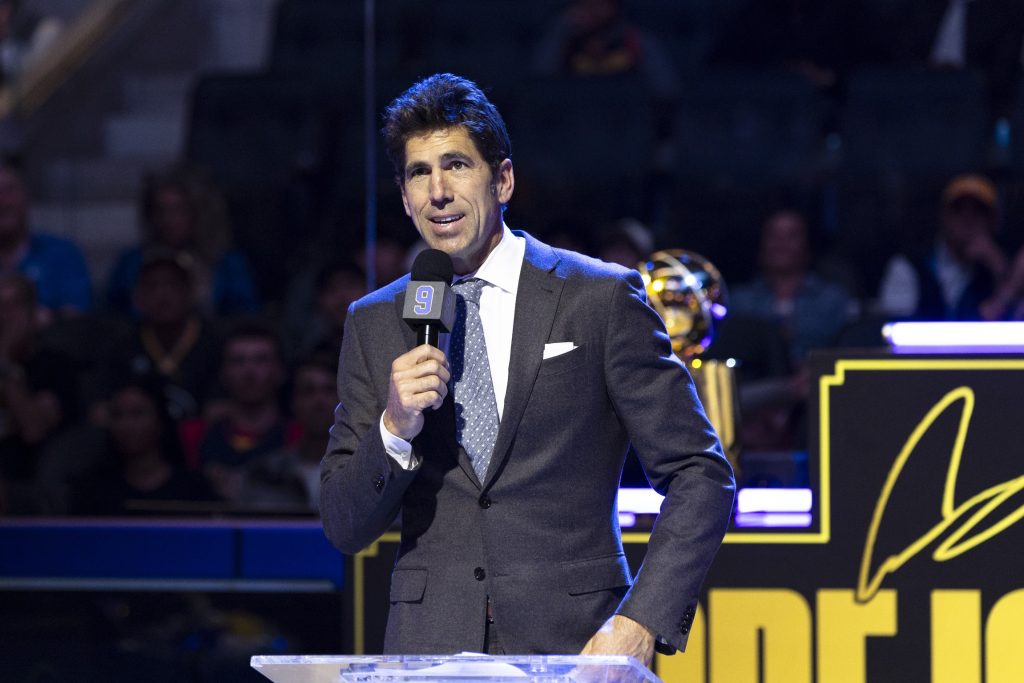
The Sixers officially moved on from Daryl Morey as the President of Basketball Operations following the second-round sweep at the hands of the New York Knicks, marking an end to his six seasons as the lead decision-maker for the franchise.
What’s next is a more complicated question for the organization. Josh Harris faced the media alongside Bob Myers to announce the decision, with the press conference featuring more of Myers being introduced to the Philadelphia media than anything else.
While there was little of substance in the answers from both men on the stand, what has been made clear is that Myers will be leading the charge for the next hire and remain involved in the future direction, with his current title as interim President of the Sixers in mind.
Why There is Already Weirdness in the Bob Myers Era
The spidey senses have been tingling regarding Bob Myers’ looming presence in the organization for quite some time. He officially stepped down from his role as GM of the Warriors in May of 2023. After spending some time as an analyst with ESPN, Myers was hired by Harris Blitzer Sports & Entertainment in October of 2025. His official title was “President of Sports,” and the mission statement was maximizing opportunities and bolstering processes across each of the HBSE ventures, which include the Philadelphia 76ers, the Washington Commanders, the New Jersey Devils, Crystal Palace F.C., and the NASCAR team Joe Gibbs Racing.
There were whispers that this was essentially the Sixers laying the groundwork for Myers taking Daryl Morey’s job from the second this hire was made. It feels fair to assess that Josh Harris valued his opinion and professional resume to the point where he essentially hired him without having a clear job for him and figuring things out down the line.
These whispers only got louder due to Myers being extremely visible across the entirety of this Sixers season. He could be spotted sitting courtside, often next to Harris or David Adelman, at most of the home Sixers games, just a few seats down from the team’s bench. This was especially noteworthy given how visibility was never a strong trait of Morey’s, and he largely consumed the action off-camera and in a suite rather than getting shown as the game went to a break. For what it’s worth, this is far more optics than anything. Both felt intentional, and there is not exactly an advantage to watching the game with your feet on the wood when it comes to making roster decisions.
But perhaps the more noteworthy point is the lack of clarity on what Myers’ role will be moving forward. He was asked about this during his media availability, and his response was as follows:
“I view [myself] taking the next few weeks, not sure how long it’ll be, to identify a day-to-day leader that’ll have a lot of authority here, which they should. What they’re going to get, and our fans are going to get, is them plus me. I won’t be on a day-to-day level, but on the high-level decision making, which is being here at the draft, being here leading up to the trade deadline, being available for free agency discussions, free agency meetings, things like that, I’m going to be involved at that level. And I can tell you that I imagine – and this isn’t, I’m not saying this lightly – I’ll be communicating with that person daily, if not five out of seven days a week. And I don’t only view that as at a job. [It is] because I want to. I want to hire somebody that I can work with. I want to hire somebody that Josh can work with. And most importantly, I want to win. And I think that I have had some experience in this space, and if I have something to say, it’s harder for me not to say it than say it. But that’ll be my role, and obviously continuing to work with Josh on all this very high-level stuff. But I’m looking forward to that role. And the best part about working in sports is the competition. If you like competition, it’s a great space to live in. But you’ve got to deal with some pain. You’ve got to deal with some loss. But when you win, it’s all worth it. But that would be how I would characterize it.”
Say what you want about Daryl Morey. He certainly was not perfect, and there are plenty of decisions that are fair to critique. But the biggest positive to the Morey era, from my view, was the fact that there was a clear decision-maker and face of the front office. There was a level of competence and normalcy that he provided, which was drastically lacking in this organization. Flashback to before he came to Philadelphia, and it was a revolving door of front office personnel, in which it was not clear who was officially making the calls.
This era of Sixers basketball started with Sam Hinkie’s vision of The Process. The NBA helped put the Colangelos in place after frustrations grew from the league about the timeline of this process. In a somewhat similar way to what is currently being seen with the Morey to Myers handoff, the Colangelos eventually took over for Hinkie, although Hinkie willingly jumped on the sword before he was stabbed in the back by it. Flash forward past some abnormally large collars and burner accounts from the Colangelo era, and it left an era of mystery for the Sixers’ front office. Elton Brand spent some time in the lead decision-maker seat, as did Brett Brown. Scott O’Neil, Alex Rucker, Ned Cohen, Marc Eversley, and Tony DiLeo each had some level of voice in what became a complete collaborative effort from the front office as a whole.
It is absolutely true that the responsibility of making every decision for a team should not exclusively fall on the shoulders of one person. But there is value in an individual being the one who has to face the music and answer questions about the outcomes. It will be interesting to see who the exact name is that gets hired to be the official President of Basketball Operations under Myers. Names like Mike Gansey, Nick U’ren, Vince Rozman, Neil Olshey, and Jameer Nelson have been mentioned as some potential candidates. But the more noteworthy storyline should be the hierarchy of the front office over who the specific name is. Any way you cut it, it feels like the organization is returning to this collaborative approach, and it likely is going to be difficult to point a finger at a specific individual moving forward.
Bob Myers’ Track Record
The phrase “Architect of the Warriors dynasty” is often attached to Myers’ name. While it is indisputable that the franchise won four championships under his reign and undeniable what an incredible PR spin this is, this does not exactly tell the story.
After starting off as a walk-on, Myers played four seasons of college basketball for UCLA and eventually played his way to a scholarship. Following his graduation, he spent time as a sports agent, which included representing players like Brandon Roy, Tyreke Evans, and Kendrick Perkins. He was hired as assistant general manager of the Warriors in 2011 and promoted to lead GM just 11 months later in April of 2012.
To flashback to this era of Warriors basketball, Golden State had just limped to a 23-43 record during the lockout-shortened season ahead of Myers’ first season in charge. Stephen Curry was limited to just 26 games played, with his ankle issues leading to some concerning conversations about his future. But Myers largely elected to run back the core headlined by Curry, Klay Thompson, David Lee, and Andrew Bogut. It is worth noting that Klay Thompson was drafted with the 11th overall pick in the 2011 draft, so Myers had some level of voice, but Jerry West has largely been the guy who has received the most public credit for this decision. Golden State’s most notable moves of Myers’ first offseason were to sign Curry to a long-term contract, draft Harrison Barnes, Festus Ezeli, and Draymond Green, trade for Jarrett Jack, and sign Carl Landry, Brandon Rush, and Kent Bazemore in free agency.
Mark Jackson was kept in place as head coach, and Golden State leaped forward to a 47-35 record to earn the seventh seed in the Western Conference the following year. The Warriors defeated the Denver Nuggets in the opening round before being eliminated by the San Antonio Spurs in the second round. Curry showed his first consistent flashes of greatness, improving his scoring to 22.9 points per game and leading the NBA in made three-pointers and three-point attempts per game.
Golden State took a further leap forward next season to go 51-31, but were eliminated by the Los Angeles Clippers in the opening round. Myers made the tough decision to fire Mark Jackson following the year, which was met with plenty of criticism at the time. But with Steve Kerr in place, the Warriors leaped into the true contenders mix, going 67-15 in the regular season and beating the Cavaliers in the NBA Finals to win the championship with Andre Iguodala added to the core of Curry/Thompson/Green/Barnes/Bogut. Golden State then went on to finish with the best regular season record in NBA history the following year at 73-9. They fell to the Cavaliers in the famous 3-1 series comeback from LeBron James and company, before winning back-to-back over this same Cleveland team in 2016-17 and 2017-18 with Kevin Durant on their side.
While winning three championships in four years is an indisputable amount of success, it is the 2021-22 championship that is probably the most impressive feather in Myers’ cap. Curry could only suit up for five total games in 2019-20 because of a broken foot, and the Warriors limped to a 15-50 overall record in the COVID-shortened season. They improved to 39-33 the following season, but still missed the playoffs outright. While Curry, Thompson, and Green remained the foundation of the team, it was a different version of Warriors basketball. Jordan Poole played an essential role (before he was KO’d by Draymond Green), Kevon Looney found his NBA niche, and Otto Porter Jr. had the best season of his career after largely becoming an NBA afterthought.
Winning an NBA championship is an extremely difficult task, and winning four makes you a made man in how you are discussed in these circles.
However, if you do want to cast a skeptical lens on Myers’ tenure, you can find things to critique. He deserves credit for keeping the train on the tracks and ensuring the organization achieved maximum success. But it not exactly fair to say he laid out the roadmap.
Getting the Grade-A star to build a roster around is the most difficult task for any front office. Myers inheriting Curry is a leg up that no other general manager has been blessed with. In addition to the transcendent talent being the greatest shooter of all time, Curry is one of the most selfless and malleable superstars in history, which proved essential as the years went on. Sure, Steph Curry of then was not the Steph Curry of now. There was a time when there were legitimate conversations about whether Curry or Monta Ellis would be the right building block of the future. But the bottom line is the cornerstone piece to make these titles possible arrived in Golden State before Myers.
The draft track record during Myers’ tenure also leaves plenty to be desired. The trio of Harrison Barnes, Festus Ezeli, and Draymond Green was a terrific draft return in his first season at the helm. Selecting Kevon Looney with the 30th overall pick the following year also should be viewed as a success. You can make a case for the Jordan Poole selection at 28th overall in 2019, although his career has taken a turn to where he was receiving DNPs on the Pelicans this year, and it was turbulent while in Golden State. Selecting James Wiseman with the second overall pick in the 2020 draft was a massive miss that seemed like it might have closed the window to win. Drafting Jonathan Kuminga with the seventh overall pick in 2021 was a strange decision given the lack of fit within the Golden State system, and the Warriors drug out his tenure far longer than probably should have been the case. Patrick Baldwin Jr., Jacob Evans, and Damian Jones also did not reach their desired heights with the franchise or in the NBA as a whole.
Making the trade for Andre Iguodala was a great move by Myers, as shown by his Finals MVP in his second season with the team. He also had some real success bringing in players seeming to be on their way out of the NBA before they found their footing with the Warriors, such as Andrew Wiggins, Otto Porter Jr., and DeMarcus Cousins. It is fair to roll your eyes at any credit for the Durant addition, given how the future Hall of Famer essentially forced his hand and made the decision easy after being eliminated by this same Warriors team the season before. But it is a results-based world that we live in, and the success of the Warriors’ organization under Myers is more than a footnote.
What This Means for the Sixers
Maybe Myers is the stabilizing force the Sixers’ organization needs. He is articulate and charismatic in a way that Morey never fully connected. However, the dynamics of the process of bringing him in and the upcoming decisions still leave a bit of a strange aftertaste. It feels like “fall guy” may be part of the job description for whoever the next hire is to work under Myers.
One of the NBA wives’ tales is that organizations sometimes have a tendency to overcorrect when making a head coaching change. Teams tend to go from a strong players’ coach to a strong analytical mind or vice versa. To some extent, this current move feels like the front office version of this.
Morey’s biggest flaws were the lack of human connection in how it resonates in the walls of a locker room, as well as being too star-driven in his roster-building approach. He is an unbelievably smart guy, who has not achieved the same level of success but also has never inherited as favorable of a position. But the Jared McCain trade is a clear example of a move that seemed to impact the team more than Morey was braced for. Sure, you can still make the case that the value of the draft capital return was an acceptable value. But McCain was among the most well-liked players in the locker room, and the deal showed the organization’s priority to shed talent rather than add ahead of the second-half push. Would McCain remaining in Philadelphia have changed the Sixers being eliminated by the Knicks? Probably not. Would it have prevented Tyrese Maxey from needing to play 47 minutes in a game during the series? Absolutely.
The biggest strength of Myers’ skill set that was put on display across his Golden State tenure was his management of personalities and egos. He has strong relationships all around the league, and you will not find any star players flying to China to call him a liar in the way that was the case for James Harden and Morey.
However, it is one thing to have some hard conversations with Draymond Green when you are talking to him on a near-daily basis. Will these conversations be received the same way by a player like Joel Embiid if Myers is not a visible face? If Myers is around the facility at a high rate to where these conversations can be had casually, it is one thing. But all messaging to this point seems to indicate this is a long shot.
Patience has worn thin with the Sixers fan base, and the organization is at a true crossroads. This could be the offseason in which the keys are fully handed over to the Maxey and Edgecombe backcourt as the Sixers build for the future. It also could be an offseason in which Philadelphia elects to tweak around the edges, with the fact that they were still a top eight team in basketball in mind. These are big decisions to be made, any way you look at it.
But the lack of clarity on the internal hierarchy of the Sixers organization leads to a bit more concern than anything at this stage of the game. The goal of the opening press conference and reports since the season ended should have been to provide confidence in the direction moving forward. It feels hard for this to be the takeaway if you sift through the corporate buzzwords and listen to what is exactly being said.
Sean Barnard has covered the Philadelphia 76ers and general Philly Sports for over six years in a variety of roles and for multiple outlets. Currently works as a Content Writer for DraftKings Network, Sixers/NBA Insider for Philadelphia's Fox Sports the Gambler, and co-host of Sixers & Phillies Digest on Youtube. Forever Trusting the Process.