
Ad Disclosure
Jaylen Brown’s First Philadelphia Season Will Be the Turning Point in the NBA Analytics Movement

By Sean Barnard
Published:
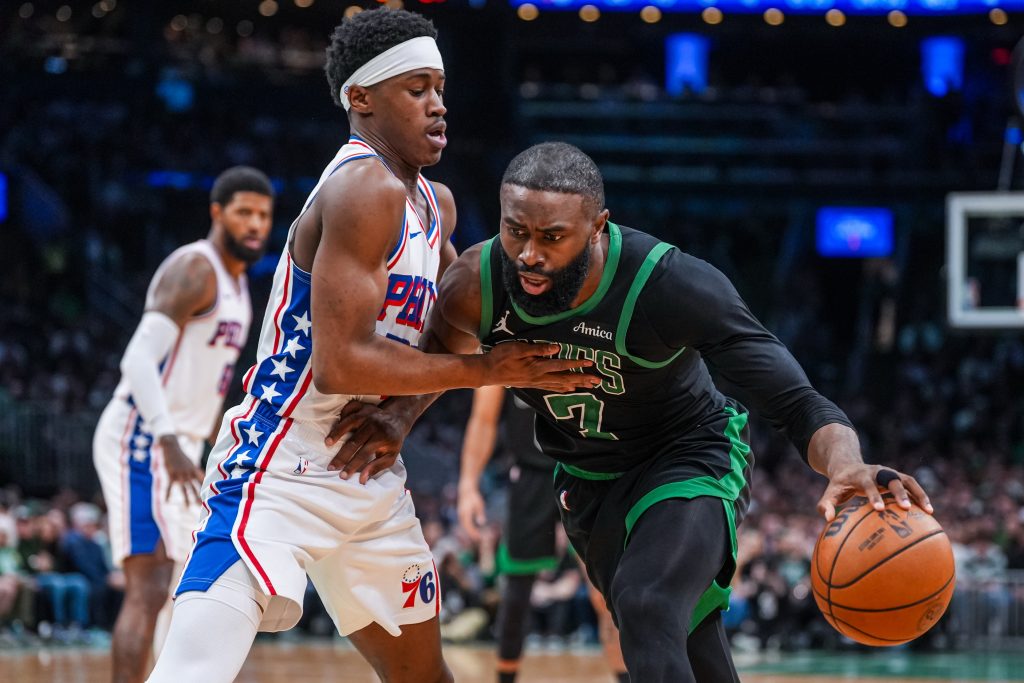
The Philadelphia 76ers made the biggest splash of the NBA offseason to this point, swapping out Paul George and some draft picks to bring in Celtics star Jaylen Brown. It’s a move that has been widely regarded as a steal for the Sixers, with the vast majority puzzled by Boston being willing to deal Brown with such urgency at this price point.
In the hours and days that have passed, it’s felt as though everyone is waiting for the other shoe to drop. Was there a smoking gun for exactly why the Celtics wanted to move on from the five-time All-Star? Did the relationship between Brown and Jayson Tatum sour to an irreparable extent? A Twitch stream rant that made his talent not worth putting up with? A trade demand from Brown directly?
Celtics’ President of Basketball Operations Brad Stevens spoke publicly to the media, and Brown took to his own platforms to give his side of the story. Stevens largely took the slant of this being a financially motivated deal with 70% of the salary cap committed to Tatum and Brown:
While I don’t reject the premise of what he’s saying, I will be the first to push back and call BS in this context.
Brown’s five-year, $285 million supermax contract carries some sticker shock with it, and he has three years remaining that will carry cap hits of $57.7, $61.8, and $65.6 million through 2028-29. However, this was not simply offloading or breaking up the contract in the trade. Boston brought back Paul George in the deal, who is seven years older and signed a four-year, $211.5 million deal to lure him to Philadelphia. This was a contract that raised eyebrows at the time and has largely been viewed as one of the worst values in the sport. George is still a clear net-positive basketball player who is consistently helpful when he is on the floor. But he was available for just 78 total games across his two seasons in Philadelphia, and is due $54.1 million next year with a $56.6 million player option for the 2027-28 season, which he will almost certainly pick up. Stevens was rightfully pressed about this by the Boston media and pointed to the deal being a year shorter, but this is still an answer that lacks substance based on the context of his initial point. Financial flexibility is not something that is provided in this trade, at least not in the short-term.
Rather, the concept that has continued to gain some steam as the dust has settled is the Celtics simply believing Brown is not as good as his reputation. The eye-test vs. analytics debates have been spirited conversations across NBA circles in recent years, and this is a deal that will be heavily attached to the debates moving forward. In many ways, Brown will largely be one of the biggest test subjects of whether his abilities were inflated due to the system around him the way these numbers suggest.
Jaylen Brown has never been a player who has been particularly favored by these advanced metrics. He is coming off a career-best season in which he was asked to be the primary offensive option while Tatum was sidelined as he recovered from his Achilles tear. Brown posted career-best marks in scoring, assists, usage rate, and tied his rebounding career-high, leading Boston to outperform all realistic expectations coming into the season. Excluding the 16 games that Tatum played to close the year, no other player on the Celtics averaged more than 17 points per game or attempted more than 14.4 field-goal attempts. It did not take an advanced eye to note that Brown was clearly the player responsible for driving the bulk of Boston’s success, that is unless you prefer watching basketball games through a calculator:
One clear area where Brown loses favor in some of the analytics is his shot selection. The three-point movement has taken over the NBA in recent years, and the Celtics have been at the forefront of this, especially since Joe Mazzulla took over as head coach. Boston ranked fourth in the NBA in three-point volume last year, first in 2024-25, first in their championship 2023-24 season, and second the season before during Mazzula’s first year at the helm. Brown is a capable three-point shooter, at 35.8% on 5.3 perimeter shots per game across his career, but is more comfortable and dominant as a slasher who gets downhill and attacks the rim. He led the NBA with 16 two-point attempts per game last season, and his 52.3% efficiency on these opportunities is good, but not stellar. For reference, Shai Gilgeous-Alexander attempted 15 two-point attempts per game last year and connected at a 60.2% efficiency on these chances, which is an elite rate. Joel Embiid shot 53.5% on his 14.2 attempts inside the arc last season.
Beyond his efficiency splits, it has been the on/off figures that have caught more criticism for the former Celtics standout. Even with all team success in mind, Brown finished last season with a -4.6 on/off rating, meaning the team was 4.6 points per 100 possessions worse when he was on the floor compared to when he was off of it. He has finished as a negative in this category in seven of the 10 years of his career. While it feels like an important qualifier that the Celtics were still posting a +6.2 rating when the 29-year-old was on the court and the team has had a positive net rating with him on the floor every season but his rookie year, these are still surprising splits. Perhaps more alarming, the Celtics went 9-2 in games that Brown did not play last season. The season before this, the Celtics were 15-4 in games that he was absent. In the 2023-24 championship season, the Celtics went 12-0 in games that Brown did not suit up for. Over the last four seasons, the Celtics are 47-10 in games that the former Finals MVP has not played, which would be on pace for a team winning 68 regular season games and likely in play for the top seed in the conference.
Going back to the individual advanced metrics that attempt to quantify Brown’s impact, it gets even more puzzling. PER (Player Efficiency Rating) is an attempted all-in-one metric that grades his impact most favorably, and labeled Brown as the 11th-best player in the sport last season. Box plus-minus and VORP each claim he was the 21st best player in basketball last year. Daily plus-minus ranks him as the 39th most impactful player in the league, while win share per 48 minutes drops him to 51st. Estimated plus-minus slots Brown as the 87th most impactful player in the sport, while the xRAPM metric is most critical and ranked Brown as the 180th most impactful player among players that logged at least 1,000 minutes last year, or the 62nd percentile of the league.
There are plenty of fair critiques about each of these numbers. I would be the first to argue that Brown should be viewed through a unique lens because he was drafted to a competitive roster when he first came into the league, and Boston has consistently done a really nice job rounding out the roster around him and Tatum. It’s a clear positive to the team that production does not fall off a cliff when the bench unit goes into the game, but one that does not help Brown’s advanced analytical profile.
But the takeaway from all these numbers, and the decision that was just made by the Celtics, seems to be that Boston at least puts some stock in these trends. Brown, putting forth a career-best season in which expectations were just about the lowest for the team, should be viewed as the type of performance that changes your perception about the NBA champion moving forward. The Celtics viewed this as a chance to sell high.
I have been a guy who has gotten in the weeds of eye-test vs. analytics debates plenty of times before. There should be no doubt that there is a place for analytics in the sport. But the nerds that act like they are the be-all and end-all, the way that sometimes occurs, is bothersome to me and has actively made sports discourse worse. I don’t accept that an NBA player is better than another simply because his VORP, PER, or Box plus/minus tells me so if my eyes see differently. This is especially the case when so many of these calculations are flawed at their foundation. I won’t bore you by diving too deep in this article, but when you actually dig into how these numbers are calculated, I don’t find the formulas for how these numbers are generated correlated to what actually makes an impact in basketball.
While you cannot dispute that these numbers exist, there are facts that matter a bit more to me than a number on a spreadsheet.
Jaylen Brown is a five-time All-Star, a two-time All-NBA player, a 2024 NBA Champion, the 2024 ECF MVP, and the 2024 NBA Finals MVP. He finished sixth in MVP voting last season after posting averages of 28.7 points, 6.9 rebounds, and 5.1 assists as the primary offensive engine on a Celtics team that finished second in the Eastern Conference with a 56-26 record. This happened while guarding the opposing teams’ best player on just about a nightly basis. Brown has never played fewer than 57 games across a regular season in his career. No player in the NBA has won more combined regular season and playoff games than Brown across the past 10 years (523).
Beyond just this, he is a guy who accepts the challenge every single night. Brown is a hard-hat player who does everything possible to play every night and competes at a high level while doing so. If his shooting percentages slip while he plays through a sprained ankle and his VORP drops a few points, so be it.
The Celtics’ level of success when Brown has not been on the floor is a bit strange. But the level of success the team has achieved when he has been on the floor is more noteworthy.
Putting all numbers to the side, there is an edge that Brown plays with that has been desperately lacking in this Sixers franchise. He is willing and eager to pick up an opponent’s best player and attack the basket with supreme strength while talking trash in the process. It feels that the gap in styles between the regular season and playoff basketball has only widened in recent years, and different players thrive in different settings. Brown has been a player who is at his best in the postseason when the lights are the brightest, even outshining Tatum on a relatively consistent basis in these settings. The game is about a bucket. It always has been and always will be.
Perfect basketball players do not exist, and Brown has fair flaws to point to. He will have some frustrating turnovers and take ill-advised shots at times. But it is extremely rare that you can acquire a player of his caliber of talent at this stage of his career, and this is a worthy swing by the Sixers, especially with the price in mind. If things click fully, the former Finals MVP can be the perfect link to the two timelines of the fading Embiid years and the upcoming season in which the Maxey and Edgecombe backcourt will run rampant in the league. There have been plenty of late-game situations where it feels like the Sixers needed someone to want the ball and go get a bucket in crunch time. Brown will willingly step into these shoes.
Outside of the Luka Doncic trade, this is one of the most perplexing trades in recent NBA history. The Bob Myers and Mike Gansey front office deserves immense credit for remaining in the trade mix as the relationship deteriorated internally and the Celtics missed out on the Giannis Antetokounmpo sweepstakes. Even if this is a deal that blows up and Brown is not the fit that was hoped, this is the type of trade that provides a spark to the Sixers on the floor and the fan base ready to support it. Brown’s level of impact is going to be a case study observed by NBA analytics people with hyper attention this coming season to see if their thesis is correct. But I am unwilling to believe the nerds know more about basketball just yet.
Sean Barnard has covered the Philadelphia 76ers and general Philly Sports for over six years in a variety of roles and for multiple outlets. Currently works as a Content Writer for DraftKings Network, Sixers/NBA Insider for Philadelphia's Fox Sports the Gambler, and co-host of Sixers & Phillies Digest on Youtube. Forever Trusting the Process.