
Ad Disclosure
How Does the Jaylen Brown Trade Impact Joel Embiid’s Sixers Future?

By Sean Barnard
Published:
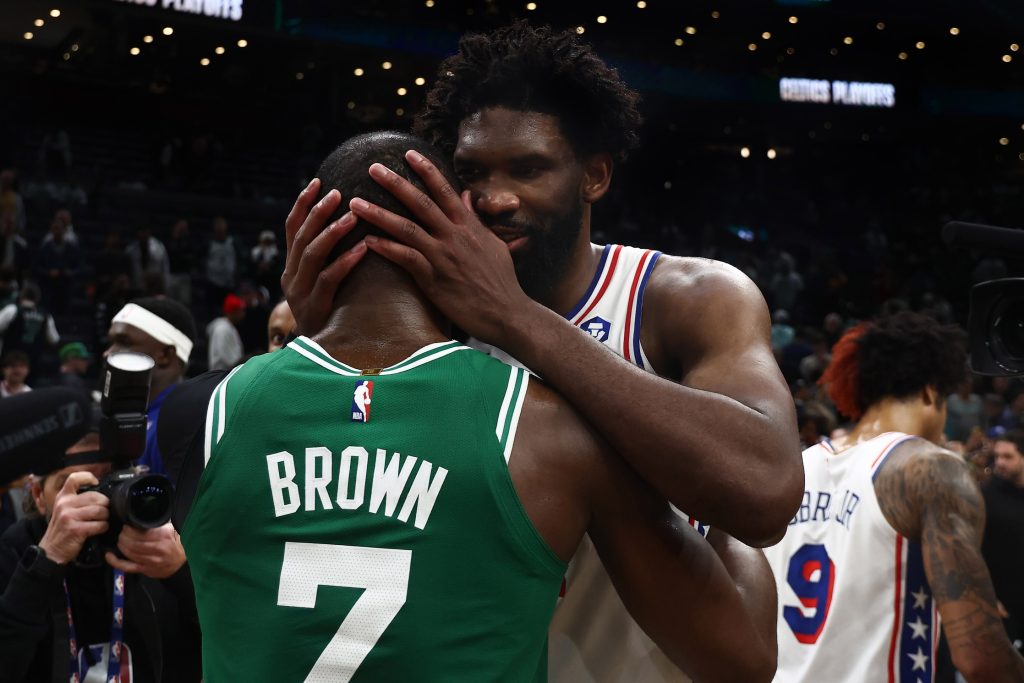
Joel Embiid is as synonymous with the Sixers as any active NBA player with their respective franchise. He was officially drafted in 2014, embraced the era of basketball by crowning himself “The Process,” and has ascended into an MVP, seven-time All-Star, and put himself in the conversation for most talented player to ever don a Sixers jersey.
But with the laundry list of injuries adding up and patience wearing thin, Embiid’s future with the organization is more uncertain than ever before. The front office regime change brings in a small circle of decision-makers with no ties to the formerly clear franchise face. These are not the guys that drafted Embiid, nor were they the ones responsible for handing him the three-year, $187.9 million extension that is just starting this coming season.
Actions always speak louder than words, and Mike Gansey and company announced their presence to the rest of the NBA by pulling off the blockbuster trade to bring Jaylen Brown to Philadelphia. It was not a massive surprise that Brown’s time with the Celtics had run its course based on the various reports that had made their way through the grapevine. But the decision to trade him to Philadelphia less than two months after the Sixers eliminated the Celtics from the playoffs was a shock in itself. The price point it took to acquire Brown, of just George, two first-round picks, and two second-round picks sent even larger ripple effects around the league.
When Brad Stevens addressed the media for the first time following the deal, he characterized this as a financially motivated trade decision. There is certainly truth to it not being easy to build out a championship-quality roster when two players make up 70.44% of the salary cap, the way it would have been the case for Boston if they had not made this trade. George being due over $54 million next year and $56.5 million the following year does make the explanation a bit difficult to fully accept. The advanced analytic nerds have wagered their war on Brown being overrated to a level that has made me question if these people even enjoy watching sports. But the biggest takeaway should be the Celtics seemingly not believing that Brown could co-exist with Jayson Tatum moving forward.
Balancing egos and personalities is an extremely underrated part of team-building. While the Celtics have largely been looked at as the gold standard of organizational practice with Tatum and Brown as the front-facing figures, it hasn’t been completely smooth. Boston is 332-167 in games that the duo had played, and they’ve gotten over the NBA Championship mountain top together. But there were undercurrents stemming for years about a rift between the two regarding the question of whose team it really is. Winning is the best deodorant, and the success they had together made everyone forget about this. But last season seemed to be a breaking point as Tatum spent the bulk of the year rehabbing his Achilles tear. While it surely was not the circumstance he hoped for, Brown got his chance to be the clear #1 guy.
There has been plenty of revisionist history about last year’s Celtics season. The reality is, it was a gap season in which there was just about zero expectations. Boston actively shed salary leading into the year, including players like Jrue Holiday and Kristaps Porzingis, to reset the luxury tax and put themselves in a more favorable position moving forward. Vegas set the Celtics’ win total at 41.5 entering the season, and there were people who believed Boston would fully enter the tank race to take a stab at collecting a top draft pick before getting back in the contending mix in a similar way to the Sixers’ acquisition of V.J. Edgecombe.
But Brown had other plans and carried the team to a 56-26 record to earn the second seed in the Eastern Conference and finished sixth in MVP voting in the process. He also proclaimed on his Twitch channel, after the playoff exit, that it was his favorite season of his career. Tatum made his return to the court for 16 regular-season games and the first six games of the postseason. But when it was the crucial Game 7 that Philadelphia miraculously won to complete the 3-1 series comeback, Tatum was unable to suit up, and it was back to Brown going to war by himself.
The level of success the team had with Brown as the clear lead option has to mean something. He’s won more games than any other player in the league since he entered it. That includes both regular season and playoffs. To overachieve to the level the former Finals MVP did last year, only to be dangled in trade rumors again, understandably stung from Brown’s point of view.
Plenty of the verbiage in the reporting about Brown’s frustration involves a desire to have “his team.” Boston very well may have felt that Brown getting a taste of this role was the proverbial toothpaste that could not be put back in the tube. But with Brown receiving a reset in Philadelphia, what does this mean for Embiid in this context? The Sixers have not so subtly begun pushing Tyrese Maxey as the face of the franchise over the past two years, as the injury issues have hit their peak for the big man. But when Embiid is available and on the floor, the Sixers still play with him as the focal point of the offense.
Many have been eager to connect the dots to Embiid’s future being up in the air. Embiid has not publicly acknowledged the addition of Brown on social media to any extent, and there have been differing reports on whether or not the two have even spoken yet. Brown hosted a Twitch stream where he talked through his emotions about the trade less than 24 hours after the deal went through. It raised an eyebrow when he called both Maxey and Edgecombe during the stream, while making no mention of Embiid across the 47 minutes he was live. It is also probably worth mentioning how much the two beefed during the Sixers vs. Celtics series, and Brown complaining about the Sixers star’s flopping following the case. But does any of this even matter in the outlook for trading Embiid if that is the organizational goal?
What Would a Joel Embiid Trade Look Like?
I have led the charge in refuting any possibility of an Embiid trade over the past few seasons. This belief largely stems from the salary cap gymnastics that it would require for a deal to even be possible, and the baggage that comes with the star. The same intimidating contract referenced for why the Sixers would be motivated to get it off the books is one that will travel with Embiid to his new team. The effects of the new CBA are being put on display all across the league, and decisions are being made more based on finances than on team-building logic out of necessity. Even if the NBA won’t acknowledge it, the second apron functions as a hard cap for teams, and there are a variety of other roster-building restrictions that every team must be mindful of. Expect even more trades moving forward that make little sense from a basketball perspective but are necessary due to the financial effects that come with them.
Acquiring a big man who has not played 40+ games since the 2022-23 season while being due nearly $58 million next year is not a decision that is going to put any NBA salary cap sheet in a favorable spot. NBA trade rules also require the salaries that are incoming and outgoing in a deal to be in the realm of the same number, with the specifics depending on the team’s financial state. With this in mind, the Sixers would need to take back significant salary for a trade to even be legal under NBA rules.
This is where the Embiid trade conversation gets especially complicated. He is not the perennial MVP candidate that he once was, and it feels unlikely he will be able to play at a more regular rate moving forward as he ages. But when he is physically right, Embiid is still one of the most gifted scorers in the league and a clear net positive on the floor. Even last season, he posted averages of 26.9 points, 7.7 rebounds, 3.9 assists, and 1.2 blocks across his 38 games played. The Sixers were 24-14 in these matchups, and he was the difference-maker in the series comeback against Boston. He mowed down the Celtics’ collection of weak options at the big man position and collapsed their entire defense. This is not addition by subtraction, nor does there feel a real pathway to “winning” an Embiid trade based on the complicated circumstances of what comes with him.
Excluding finances, the biggest reason for an Embiid trade would be the symbolism of what this means. It would be turning a page to a new chapter of Sixers basketball by removing the clear face of the previous era. Embiid has not exactly been known to be a model teammate when it comes to the treatment of his body and punctuality through the years. Is his presence disruptive to the point where it’s preventing the growth of Maxey and Edgecombe? Is this something that will be an even larger problem with Brown? These are answers that only people around the team on an everyday basis know for certain, and Brown’s personality is a new X-factor in the equation. But the point still remains that there does not feel a pathway to improving the team with an Embiid trade at this current point, which is what has to be the motivating point in the first place.
What Would Another Year With Joel Embiid Look Like?
Tied to the financial conversation, Embiid’s contract will only get easier to move as more years come off it. The Celtics made it clear that George having one season fewer left on his deal compared to Brown was a motivating factor in accepting the trade. Acquiring two years of Embiid compared to three years is a major difference from both a salary cap and health perspective.
While plenty has been made about “whose team it is,” or if Brown can be the alpha here, Embiid has never been the vocal leader type. If anything, it may be a relief to the 32-year-old that these are shoes Brown will be eager to fill. In fact, there is a fair argument to be made that the best version of Embiid came when he was being pushed by Jimmy Butler. Brown is not quite as combustible or stubborn a personality as Butler, but there are similarities in their mindset and approach. However, unlike Butler, Brown has a championship ring on his finger and a Finals MVP to go with it. He has been there, done that, and has a chip on his shoulder to do it again. There will need to be basketball adjustments as they learn to play together on the floor, but from a personality standpoint, it feels hard to imagine Embiid will be problematic in this context.
Perhaps my favorite aspect of the Brown trade is the way the Sixers’ regular-season floor has been raised in a major way. For the bulk of Embiid’s career, the Sixers have largely been a good team when he is available and a bad team when he can’t play. But with Brown joining the dynamic backcourt of Maxey and Edgecombe, there is a clear pathway to the Sixers remaining competitive and near the top of the Eastern Conference mix even without Embiid.
It is unfair to consider Embiid a bonus in their outlook, but the Sixers will have the luxury to fully embrace whatever is deemed the best load management gameplay to maximize his impact. This is a difficult needle to thread, but Brown’s availability changes the equation quite a bit. George was actually a solid fit as the third option next to Embiid and Maxey. But the pathway to success for them as a trio narrows when availability issues impacted both George and Embiid. Brown has never played fewer than 57 games in a season and has played 70+ in five of his 10 years in the league.
The LeBron James sweepstakes are still underway, and it feels like any conversations about Embiid’s future and the best direction for the Sixers have stalled until he makes his decision. But regardless of his choice, you only get to make the Embiid trade once. Moving him at a low point in value without a clear path to improving the team could be something the Sixers ultimately regret without at least seeing the vision through for this new iteration of the roster. The Brown blockbuster deal was the spark needed to inject some life back into the franchise, and having three high-impact players under 30 makes it tolerable to live with the ups and downs of Embiid.
Sean Barnard has covered the Philadelphia 76ers and general Philly Sports for over six years in a variety of roles and for multiple outlets. Currently works as a Content Writer for DraftKings Network, Sixers/NBA Insider for Philadelphia's Fox Sports the Gambler, and co-host of Sixers & Phillies Digest on Youtube. Forever Trusting the Process.