
Ad Disclosure
Did the Dodgers Break Baseball? Maybe MLB’s Business Environment is More Dynamic than Salary Cap Proponents Would Have You Believe

By Tim Reilly
Published:
The Phillies continue their West Coast swing with a trip to Los Angeles for a three-game set against the Dodgers. The series marks a return to Dodger Stadium, the site where the Phils’ 2025 campaign came to a gut-punching halt, their postseason chances sailing away like the ball Orion Kerkering threw past J.T. Realmuto:

Some things have changed since that bitter October night in the City of Angels. Don Mattingly has replaced Rob Thomson as manager. Zack Wheeler has returned to the rotation, minus a rib but otherwise looking like his dominant self. And Kerkering has emerged from his moment of torment to become one of the most dependable relievers in the bullpen, adding a splitter to his repertoire and pitching with renewed confidence.
But the more things change, as the old proverb goes, the more they stay the same. The Phillies continue to pair dominant pitching with a dysfunctional offense that will feast and then disappear without a trace. Despite the club’s flaws, it would not be a surprise to see them back in the playoffs.
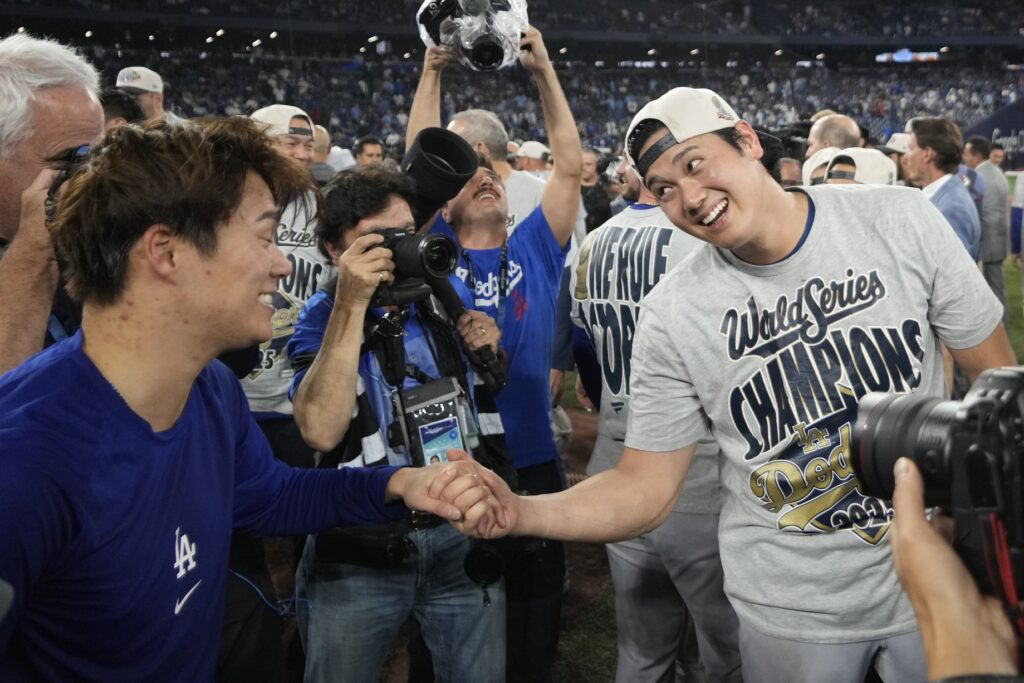
The Dodgers, meanwhile, remain a juggernaut. Winners of the last two World Series, Los Angeles reloaded in the offseason, signing the best hitter on the market in Kyle Tucker and pairing him with the best available closer, Edwin Díaz. The free agent additions ballooned their payroll to a whopping $300 million, which doesn’t account for the more than $1 billion in deferred obligations on the franchise’s books. Leading the way on that front is the contract of Shohei Ohtani, which features $20 million in salary over 10 years and $680 million in deferred compensation.
The Dodgers’ success and treasure chest have earned the scorn of fans across baseball who have grown tired of most of the best athletes going to Hollywood. Sensing an opportunity as the current collective bargaining agreement with the Major League Baseball Players Union (MLBPA) ends after the season, Major League Baseball and its commissioner, Rob Manfred, are fully leaning into the payroll disparity created by the spendthrift Dodgers. They propose a hard salary cap to solve the problem and restore competitive balance to the field.
“Our payroll gap from top to bottom is $446 million. That’s not a fair fight,” Manfred told ESPN personality Pat McAfee in an interview yesterday. As McAfee’s colleague Jeff Passan noted in his column about the simmering labor dispute, Manfred arrived at that number by adding the Dodgers’ 2025 payroll and the club’s $169 million luxury tax penalty payment, all of which is distributed to various MLB initiatives (pension funds, payments to teams that did not exceed the Competitive Balance Tax (CBT), etc.) and none of which directly benefits LA’s on-field product.
For more than 30 years, the league’s small-market teams and an assortment of cost-conscious owners have angled for a salary cap. In 1994, the Yankees and George Steinbrenner served the role of deep-pocketed destroyers of the game. Now, it’s the Dodgers who are playing the heavy.
In fairness, the playing field is not remotely level. The current top five spenders in baseball—the Dodgers, Mets, Yankees, Phillies, and Blue Jays—reap the benefits of the large metropolitan areas from which they draw their fans. That means bigger stadium crowds, which means more money from tickets, merchandise, and concessions. It also means more lucrative television packages for local media rights. The Phillies, for example, are in the midst of a twenty-five-year, $2.5 billion deal with Comcast for the broadcast rights to their games.
Large though that number may seem, it is dwarfed by the package the Dodgers negotiated with Spectrum. That deal also spans a quarter century and pays Los Angeles more than $8 billion over the life of the contract.
Meanwhile, as cable customers began cutting the cord, unexpected pressure was placed on the regional sports networks providing a stable source of funds for other teams throughout the league. The biggest domino fell in 2023, when Diamond Sports Group filed for bankruptcy. Fourteen organizations were impacted by this financial disruption.
The upshot is a change in strategy, one that will wind down the local distribution of games in favor of a centralized approach. ESPN’s Alden Gonzalez reported in February that MLB “hopes to possess the local rights for all 30 of its teams by the end of 2028 and sell them as a national package, a process that would help to eliminate blackouts.”
Wading through the details of future business deals might seem tedious to the average fan, and I don’t expect there will be much appetite for people struggling to make ends meet in their own lives to get invested in a dispute between billionaire owners and their (mostly) millionaire employees over the best way to slice the revenue pie. They’re all eating a lot better than the rest of us, after all.
That said, we should all tread carefully before joining in this convenient effort to demonize the Dodgers for outspending the competition. Sure, it’s frustrating that they seem to be in on every free agent and trade target, frequently outbidding everyone else. But why is it always the same 5-7 teams at the auction booth? If MLB is prepared to implement a $171 million salary floor, which is $20 million higher than the MLBPA proposed, why are half the teams in the league below that floor right now?
Why does a team like the Chicago White Sox, residing in the third largest city in America, only spend $90 million in payroll? Why can’t the Miami Marlins, situated in a baseball-crazy part of the country and playing in a state-of-the-art, taxpayer-subsidized stadium, figure out how to draw a crowd? How does it benefit any of the 30 teams to have the A’s play in a minor league park in Sacramento through next season, and is it really a sure bet that the team will take off in Las Vegas? Why isn’t Pirates ownership taking advantage of a beautiful ballpark and building a winning club around its bevy of young talent, headlined by Paul Skenes?
How are the Dodgers, despite having over $100 million in talent out on the injured list, still comfortably ahead in the NL West?
Why are the Tampa Bay Rays, Cleveland Guardians, and Milwaukee Brewers all leading their respective divisions despite being among baseball’s lowest spending teams? Why are the Mets floundering despite their heavy spending? Speaking of the Brewers and Mets, might there have been a benefit to Milwaukee trading ace and impending free agent Freddy Peralta to New York this past offseason and netting two top prospects in return? Isn’t this the way shrewd small-market clubs have thrived, developing talented players and enjoying their best years on team-friendly terms (facilitated by MLB’s service time rules) before shipping them to a larger market that will pay premium price for past performance in the player’s post-prime years? Are the Brewers better served paying Peralta top dollar? What happens if he gets hurt as he ages? And what about Peralta? After working his way through a contractual arrangement that depressed his value, isn’t he entitled to pursue the highest salary a team is willing to offer without an arbitrarily-assigned ceiling on player spending negatively impacting his market?
If the economics of baseball are unworkable, why did the Padres fetch a sale price of $3.9 billion? Why are investors lining up to bring an expansion team to Portland, Salt Lake City, and Nashville?
All of these questions point to a business environment that is a lot more dynamic than Manfred and salary cap proponents would have you believe. Big money can be spent poorly (thanks for the memories, Nick Castellanos and Taijuan Walker), and smart teams operating on shoestring budgets can thrive through drafting, development, and on-field strategy (see: Rays and Guardians). In fact, their lack of investment in player salaries might well be a choice.
Does this mean the status quo should prevail as the owners and players negotiate a new agreement? Not necessarily.
But let’s not delude ourselves. Major League Baseball framing the Dodgers as an organizational bogeyman in their quest to secure a salary cap is a PR tactic, one that conveniently lets a number of owners off the hook for their own business decisions and failings.
Tim Reilly is a freelance writer from Northeast Philadelphia. He can be reached at reillyt7@gmail.com.